The path to my cabin began with softness.
Not the curated softness of a retreat designed for comfort, but the ground yielding gently beneath my shoes as I followed the narrow forest trail at Phakalane Retreat in Hout Bay. Softness, too, in the way afternoon light filtered through dense foliage, settling into quiet greens across the forest floor. Ferns leaned into the path, the air cool and still, the landscape holding a quiet gentleness.
Somewhere along that short walk, my own pace began to mirror it. By the time I reached my cabin, something inside me had already loosened. It’s one of the subtler luxuries of a place like this – the way it begins working before one fully understands what has shifted.
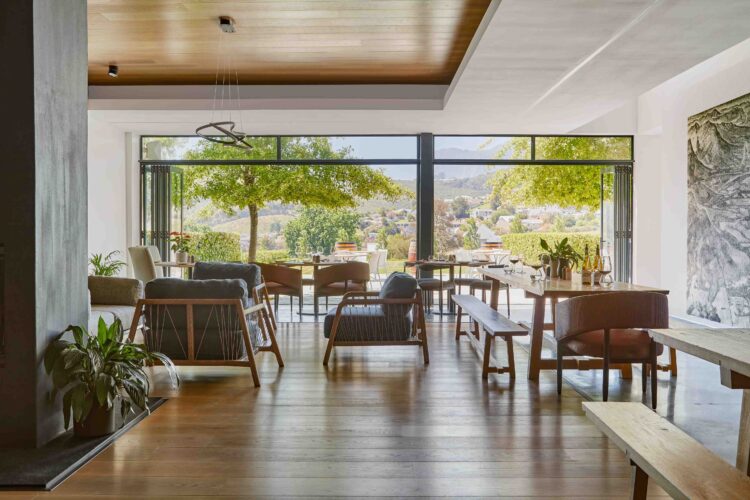
Inside, glass, muted timber, and silence felt composed less as design than as care. Luxury here did not arrive through abundance but through the sensation of being gently received. A fireplace for cooler Cape Town evenings, an outside bath inviting lingering, and wide panes of glass showcasing the trees.
From the deck, the forest opened towards the back slopes of Table Mountain above Hout Bay, where the Atlantic presses into the curve of the Cape Peninsula. The air carried that mountain clarity where sea and forest seem to breathe through the same landscape.
Later, sitting with owner Nikolas von Cramer-Klett, the atmosphere I’d felt from arrival came into sharper focus. The idea of the retreat had been with him for years, shaped by time spent in Southeast Asia and a life of seeking. He spoke of calling, simplicity, and spaces that help people slow down enough to hear themselves again.
Phakalane grew from that impulse. Not as an escape, but as a place where life might be encountered more attentively. Guests come for private stays, facilitated retreats, or individual sessions, moving between quiet rooms, the temple space, the forest, and the practitioners who work there through listening, meditation, sound, and energy practices. The point, as I came to understand it, is not to prescribe one route inward, but to create conditions in which a guest can meet whatever surfaces.
The forest as teacher

At Phakalane, design does more than frame experience; it eases the nervous system into another register. Kerry Burns, with whom I did a deep listening and energy balancing session, works through a blend of intuitive healing, energetic support, and mindfulness-based practice. In the session itself, part conversation and part energy work, she moved with calm attentiveness around my chest and shoulders, pausing at moments that felt guided by something deeper than method alone. Later, she spoke about the retreat’s structures being in conversation with the land, and how that conversation invites settling, softening, and a quiet pull toward stillness.
After my session with Kerry, I returned to the deck at my cabin. There, the quiet did not feel empty. It felt active, drawing thought down from its usual surface noise into something slower and more truthful. In that kind of silence, the questions a person carries do not disappear – they become easier to hear.
On my second evening, the bench outside became its own cradle beneath the canopy of trees. As the last light thinned through the branches, I drifted into the forest air and a sleep that held me for almost two hours.
That was when I began to understand what made Phakalane so affecting. It did not thrust revelation upon me. It guided me toward truths that had long been flickering at the edge of life. The value of silence. The grace of moving more slowly through uncertainty. The importance of returning to an internal navigation system that can discern what is truly ours from what has merely attached itself through noise or expectation.
Listening beneath the noise
The following day I spent two hours in a deep listening session with Simba, the name by which Willem Botha now moves through the world, and what had begun to stir opened further. The session was not a sound bath, nor guided meditation in the conventional sense. It was closer to a deeply held conversation, though even that does not quite capture it. Simba listened without trying to rescue, redirect, or fill the space with his own interpretation. His presence allowed me to speak more freely than I had expected, and as I spoke, I began to hear myself differently.
Years of spiritual study and varied trainings inform the way he listens, but he is careful not to make those disciplines the client’s burden. He told me that, before any modality, he’d noticed how much genuine listening has disappeared from modern conversation. Too often, people interrupt, relate everything back to themselves, or try to soothe discomfort too quickly. In his sessions, he works instead as witness. “I create a channel through which you can record your story into the archive of the universe,” he told me.
It is an extraordinary way of describing witness. It returned me to something both sessions had made clear: to be properly heard is not a passive experience. It can become a form of restoration.
Supper, slowly

The same sensibility extended to the table. Marlien Wright, author of The Yoga Kitchen, health coach, and kinesiologist, prepared one of the evening meals during my stay. Butter chicken curry with jasmine rice, onion bhajis, and salads. It was comforting without feeling heavy and generous without being indulgent – the kind of food that restores through warmth, colour, and texture.
Later, as the warmth of dinner lingered, she spoke about home food, one-pot meals, and the quiet power of vegetables, spices, and variety. She spoke about making dishes from plants, not in a plant, and about the energy that enters food when it is prepared with love. It echoed Nikolas’ reflection to me on how much contemporary food culture has been stripped of life.
Supper at Phakalane felt like a quiet rebuttal to that. Everything was considered. In a luxury landscape often preoccupied with abundance, this was something finer.
What the stillness leaves behind

Time on the back slopes of Table Mountain did not deliver sudden reinvention, but something quieter and more valuable.
Phakalane offers the rare conditions in which something already present can come fully into view. The forest, the practitioners’ quiet attention, and the unhurried rhythm of the place work in subtle concert, creating a stillness in which intuition and deeper questions can surface without distraction.
I still think about that bench outside my cabin, the forest breathing around me, and the improbable luxury of feeling safe enough to fall asleep beneath the trees. That was the deepest gift of Phakalane.
It did not ask me to become a disciple of someone else’s system. It affirmed a path I was already on.
More information: Phakalane Retreat
All image credits: Ryan Enslin