

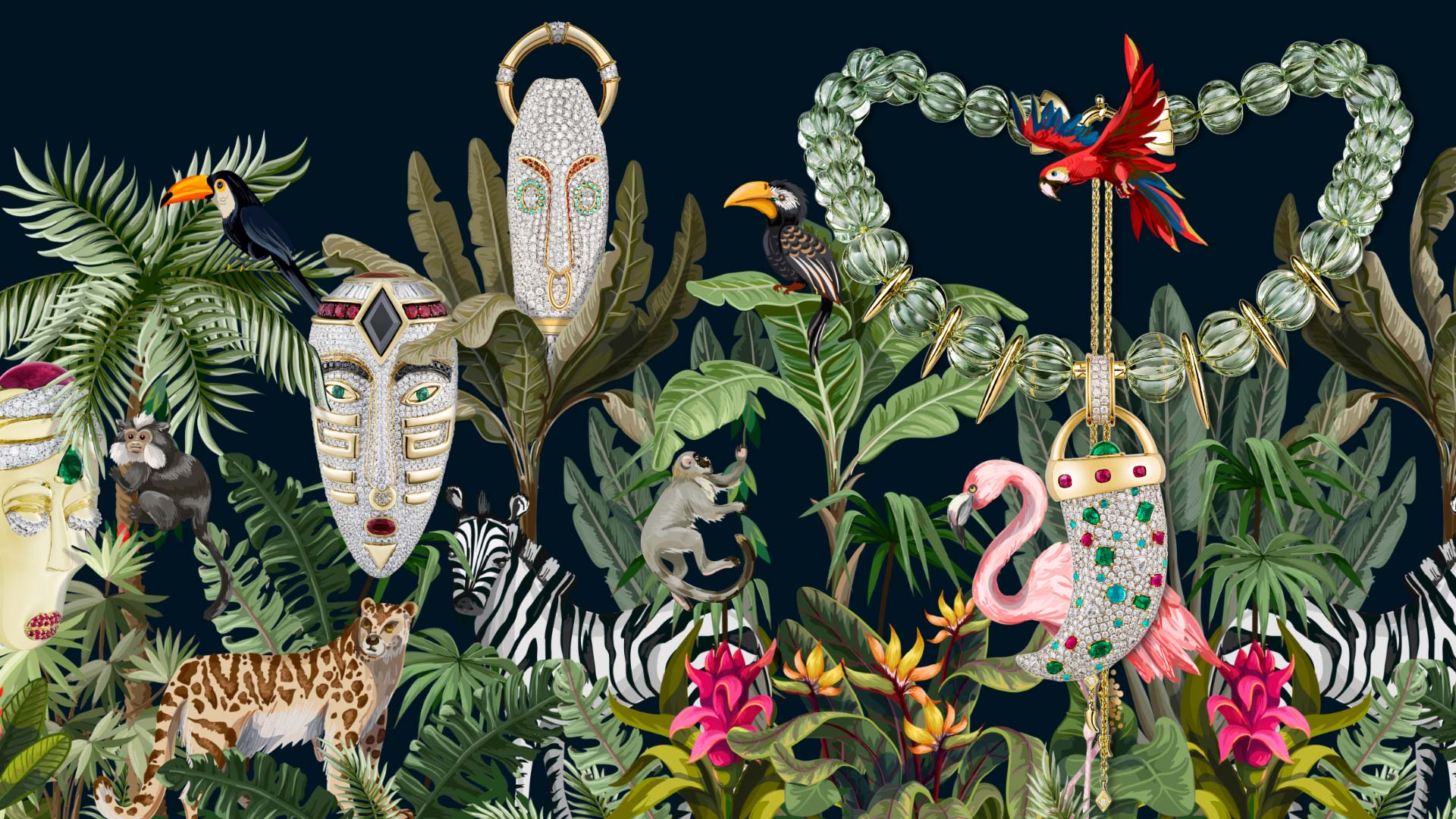
Africa’s wild plains, rich traditions, music, and cultural diversity have long captivated artists worldwide. For Italian designer and gemmologist Giuliana Loglisci, the continent is a lifelong muse — one that recently inspired the launch of the Bahati Project, a multimedia art installation in Dubai. Though she has yet to set foot on African soil, her creations pulse with its rhythms, colours, and spirit.
The Bahati Project is more than jewellery. It is an immersive world where Africa’s essence is translated into gold, gemstones, music, and storytelling. Fusing the precision of high jewellery with the untamed spirit of the continent, Giuliana’s vision pays tribute to Africa’s traditions and spiritual connection to nature. Bahati — meaning “luck” in Swahili — is both an artistic statement and a cultural bridge, designed to awaken the senses and spark conversations that transcend borders.
YLA: Your work with Bahati Jewellery is deeply tied to Africa. Can you share the personal journey that first drew you to the continent and how it continues to shape your creative vision?
Giuliana: My passion for Africa has been deeply rooted since childhood. I’ve always been fascinated by how African cultures remain connected to nature, to the spirit world (I’m not religious, but I deeply believe in spirit and energy), to their traditions, colours, music, and voices. Everything draws me in. I have always seen Africa as a dream — the origin of all humanity. After all, we all come from ‘Mama Africa’, right?
As a child, my love for animals was the first spark. I dreamed of becoming a veterinarian and moving to Africa to protect wildlife, so I watched every National Geographic programme I could find. Curiosity led me from one passion to another, and over time, Africa became a magnetic force for me — even though, surprisingly, I haven’t visited yet.
YLA: The Bahati Project has become more than just a jewellery line – it feels like a cultural dialogue. How do you weave Africa’s stories, landscapes, and textures into your designs?
Giuliana: My world is fuelled by imagination — it’s the driving force behind every creation I bring to life. Once I began to truly understand African culture (and I never stop learning, always remaining curious), its colours and motifs, I internalised them.
I believe we are the masters of our lives, and the only limits are those we set for ourselves. For Bahati, I removed those limits completely. Each piece is meticulously crafted, often taking between four and nine months to complete. When I began this journey two-and-a-half years ago, all I had was a blank canvas. As a lover of all forms of art, I created an immersive world where the viewer can enter through every sense — music, jewellery, painting, and visual art.
YLA: Music is often described as a universal language. How has African music influenced your creative process, and do you find a rhythm or melody in the way you design?
Giuliana: When I create, I don’t overthink — I follow the flow of creativity without boundaries. It feels as if my creations speak to me in a language beyond words. When I envision a piece, I already see the story, hear the melody, and imagine the photo shoot. Music, as you said, is the universal language — one of the most powerful ways to transmit emotion. The other is storytelling, which I also use. When you read something or hear a melody, you feel. My goal has always been to create a sensory experience where the viewer immerses completely into the Bahati world.
YLA: Beyond music, Africa has a rich artistic heritage in sculpture, textiles, and craft. Which specific artistic traditions or contemporary African artists inspire you most?
Giuliana: Africa is home to extraordinary artists, but my inspiration hasn’t come from one in particular. In Bangkok, where I have my head office, I discovered and collected many old books about African tribes, traditions, cultures, masks, and spiritual beliefs. I mixed the real information I found with my imagination andfeelings, creating a world infused with traditions, love, and respect for such a beautiful culture.
YLA: When working with precious materials, there’s often a parallel between craftsmanship and performance. Do you see your design process as having a musical or theatrical quality?
Giuliana: I’m a perfectionist when it comes to my work — though I also believe perfection doesn’t exist, except in nature’s beautiful imperfections. Creating jewellery at this level is meticulous work. It requires patience, precision, and an eye for details smaller than a millimetre. Each piece can take months to complete, and mistakes are costly, so care is everything.
Bahati art pieces are made for people who dare — those who love African energy and aren’t afraid to wear a brooch with 20 carats of top-quality diamonds and 50 grams of 18kt gold, for example. I want everyone to admire these works and be inspired by the beauty of African culture, music, rhythm, and spirituality.
YLA: Bahati means “luck” or “fortune” in Swahili. How does this philosophy translate into the pieces you create and the emotions you hope they evoke in the wearer?
Giuliana: Yes — Bahati means “luck” in Swahili, a word I find beautiful and full of hope. We all need a touch of luck in life. Drawing from that meaning, I extend my deepest wishes for prosperity and success to all who encounter this project – whether they wear, admire, or contribute to it. My hope is that each piece carries with it a sense of good fortune and positive energy.
YLA: You’ve worked in a luxury space while staying connected to authentic cultural roots. How do you strike a balance between high-end appeal and honouring the traditions that inspire you?
Giuliana: I love art, beauty, and craftsmanship — but I remain grounded in who I am. I create luxury, but I am not defined by it. To honour the place that has given me so much inspiration, I plan to give back by opening an art school for talented children in Africa. Once the Bahati pieces are sold at a special auction, a percentage will go directly to funding the school, giving young artists the opportunity to shape their own futures.
YLA: Looking ahead, how do you envision the next chapter for Bahati jewellery and the Bahati Project — both artistically and in terms of its cultural footprint?
Giuliana: I have a clear vision: I want the Bahati Project to be appreciated and experienced worldwide. I dream of showcasing it in national museums in London, Paris, Cape Town, New York, and beyond — bringing it to as many audiences as possible.
This journey has been entirely self-funded, built from the savings I earned through my first brand, named Lucy G. Was it easy? Not at all. But sometimes you must believe in your dream more than anything else to make it happen. It took 30 months of constant work to bring Bahati to life. I revealed it for the first time in April 2025 at my solo exhibition in an art gallery in Dubai. From here, I trust the right opportunities — and the right people — will align to carry it forward.
Contact [email protected] to find out more.


