There’s a moment in every encounter with Daniel Popper’s work when the monumental becomes intimate. His towering figures – often women, often still, often holding space rather than commanding it – don’t demand attention so much as invite presence. They’re not loud, despite their scale. They breathe. They wait. And in that waiting, something unexpected occurs: the viewer simply is.

It’s a quality that traces back to the artist’s origins. Raised in Cape Town, Daniel now works internationally, but the landscape of his childhood continues to pulse beneath the concrete and fibreglass of his sculptures. “South Africa shaped me deeply,” he reflects. “The contrasts, from its beauty and brutality, to its softness and resilience, trained my eye to hold complexity. I do think I carry a South African sensibility: grounded, resourceful, and attuned to landscape and context wherever I work.”
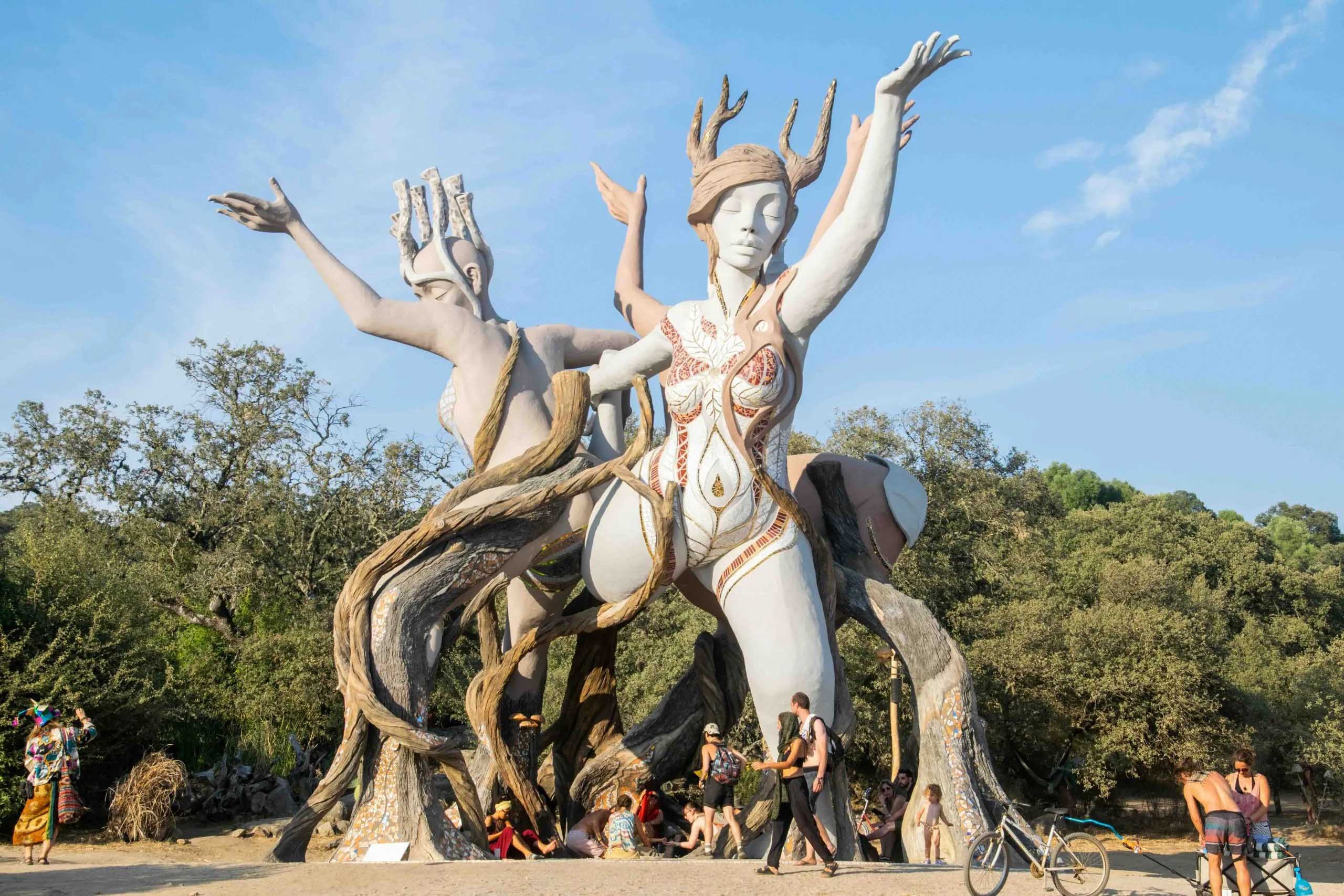
That attunement is evident. Unlike so much public art that announces itself in capitals, Daniel’s work listens. It responds to topography, to light, to the particular quality of air in a given location. His figures – made from Fibre Glass Reinforced Cement (FGRC) – emerge from their surroundings as though they have always been there, half-revealed, waiting for the right moment to step forward. “The landscapes of the Western Cape, indigenous philosophies that emphasise interconnectedness, and the raw physicality of local craft traditions have all shaped my practice more than any single artist,” he says.
It’s tempting to describe Daniel’s sculptures as spiritual, though he resists easy classification. “Spirituality isn’t something I consciously impose,” he clarifies, “but it’s embedded in my curiosity about being human. If the work feels sacred or transformative, that’s because it creates space for people to encounter themselves more honestly.”

That encounter is deliberately sensory. Daniel trained originally in theatre and set design, and his understanding of space remains fundamentally theatrical. “Theatre taught me about presence, scale, and storytelling through space,” he explains. “Even in permanent works, I think theatrically – how a piece is revealed, how it’s approached, how it holds attention without needing explanation.”
The body is central to this choreography. Daniel designs not for the eye alone but for the hand, the skin, the breath. “The tactile experience is fundamental to my work,” he says. “Touch grounds people in the present moment in a way vision alone often can’t. I design with a sensory journey in mind – how the body moves through space, how surfaces feel under the hand, how scale affects breath and posture.”
Yet for all their grounding in the physical, his sculptures resist rigidity. Daniel speaks of his works as “evolving organisms rather than fixed objects.” Weather, light, and the slow creep of vegetation are not threats to his vision but collaborators. “I intentionally leave space for nature to intervene,” he says. “Growth, weathering, and decay are not flaws, but collaborators. The work is shaped over time by light, plants, and climate.”
This willingness to relinquish control extends to his creative process. Each large-scale piece begins as something private, like a loose sketch, a digital study, or a form that may never be realised. “In the studio, I experiment freely,” says Daniel. “Small studies, digital sketches, forms that may never be seen publicly. That space keeps the work playful and prevents it from becoming formulaic.” From this embryonic stage, a sculpture moves slowly into the world, gathering collaborators as it grows. “Each piece begins as a loose sketch or digital form and gradually becomes an architectural and collaborative process involving engineers, fabricators, and installers. The tension lies in translating something intuitive into something structurally sound. The satisfaction comes when the final work still feels alive and effortless despite that complexity.”
Collaboration, for Daniel, is not a necessary compromise but a generative force. “An ideal collaboration is built on trust and shared curiosity,” he says. “I learn constantly from engineers, fabricators, and landscape architects, especially how to let the work be stronger than my original idea.”

That surrender – to material, to climate, to time – is perhaps what distinguishes Daniel’s public art from so much else in the field. His permanent works are not designed to dazzle in the instant but to endure across decades. “Permanence demands a deeper responsibility,” he acknowledges. “I think more carefully about materials, longevity, and how the work will age with its surroundings. The sculpture has to earn its place over decades, not just moments.”
The quietest measure of his success is not critical acclaim or institutional recognition but the behaviour of audiences. “The most rewarding moments are quiet ones,” admits Daniel. “Someone sitting in silence, a child exploring without instruction, people using the work as a place to pause rather than perform.”

For an artist whose figures command such physical presence, it’s a curiously self-effacing ambition: not to be looked at, but to provide a place from which to look. One thinks of his recurring motifs – hands cupped to hold light, chests opened to reveal interiors, faces tilted as if listening. These are not simply sovereign forms but vessels.
Looking ahead, Daniel’s aspirations remain characteristically spacious. “I’d love to create a large-scale, inhabitable work embedded in a wild landscape,” he says. “Something timeless, free from commercial constraints, where art, nature, and ritual quietly coexist.”
It’s a vision that returns, full circle, to the landscapes that first shaped him. Not simply as nostalgia but as continuity. His sculptures, for all their global itinerancy, remain rooted in that early training: to hold complexity, to honour context, and to make space for the encounter that follows silence.