

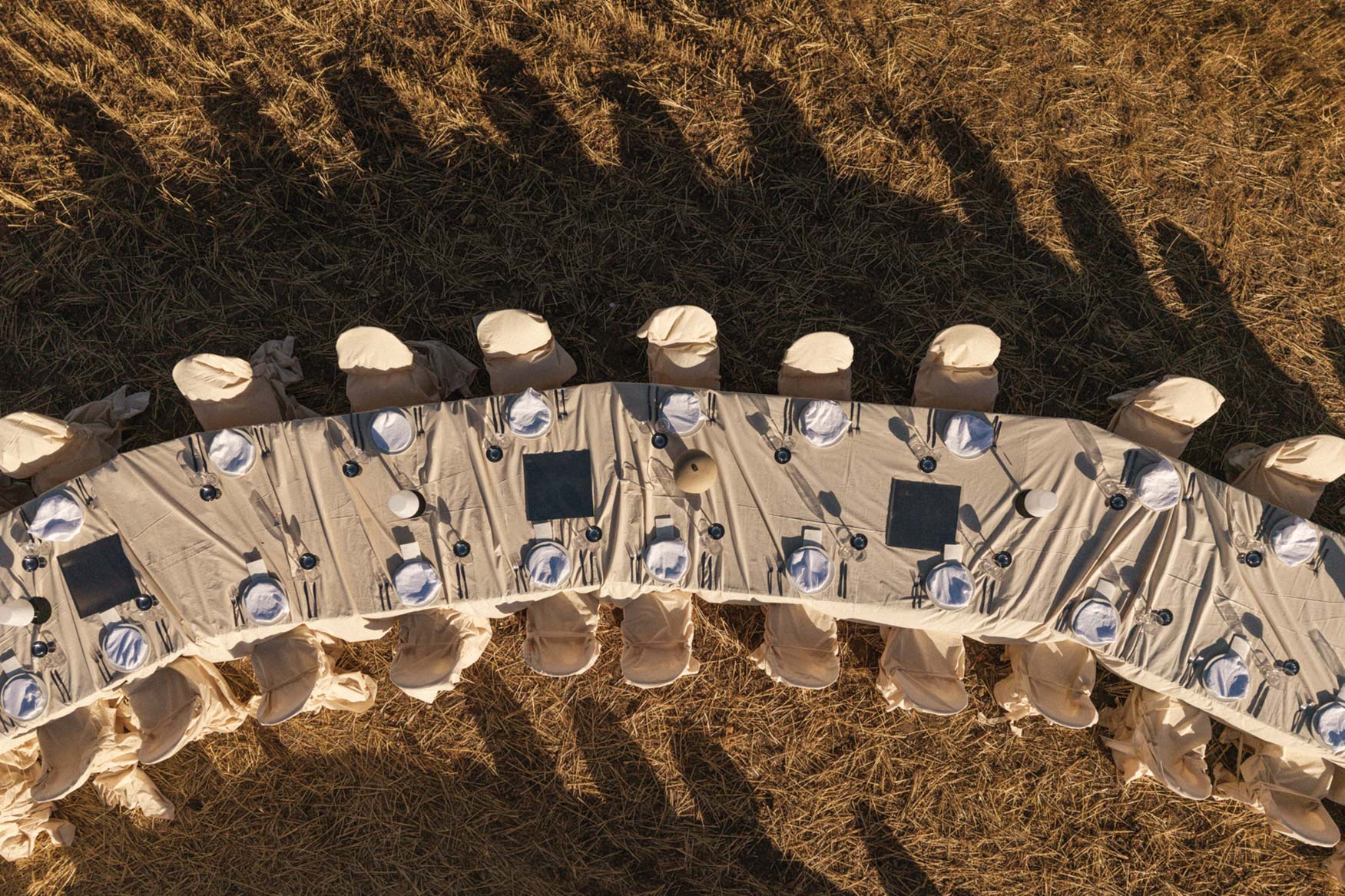
For a while now, long-table dining has fascinated me. Perhaps it’s born from my affection for the strange.
The idea of strangers gathering around a single table, eating well, listening closely, and discovering new stories feels like a deliberate pleasure. It promises the quiet thrill of not knowing who you might become for an evening.
That fascination needed testing. The pull lay in discovering whether a ticketed evening at such a table could still deliver something real, or whether the promise of connection would thin under scrutiny. Whether asking strangers to engineer social intimacy could echo the ease of long, lazy family lunches on a Sunday, or reveal how fragile that ease becomes once it is designed rather than inherited.
“It promises a quiet thrill of not knowing who you will become for an evening.”
The Kraaktafel experience entered my field of consciousness through an image I could not shake. What it stirred in me was a sudden longing, not just for the setting, but for the invitation it implied. The chance to step into an evening where familiarity was suspended, and attention mattered. An evening where I would have to show up fully among strangers and discover who might meet me there.

Learning to Sit Together
South Africans are often noted for their sociability; for an ease with conversation that crosses age, origin, and background. Social dining here draws on that instinct and shapes it with intention. In Cape Town, Reverie Social Table slows people into presence, pairing seasonal cooking with a single shared table that insists on attention and care.
In Johannesburg, the Yeoville Dinner Club stretches the long table into a Pan-African narrative, where migration, music, and memory are inseparable from the meal. You sit above Rocky Street, an area marked by volatility and risk, and choosing to go already feels like crossing a line. That tension does not disappear upstairs, but it is transformed. Conversation disarms caution. Regulars return not because it is comfortable, but because it works –- because the table asks something of you and gives something back in return.

Even on St Helena Island, chef Dan Flory’s pop-up dinners fold strangers into island time, though one evening paired me with a guest whose refusal to engage revealed how proximity alone does not guarantee connection.
Journey to Kraaktafel
With those tables in mind, I set off for the Kraaktafel experience, curious to see whether the promise of connection would hold. The drive into the Cape Winelands sharpened that curiosity further.
Wellington arrived as a threshold, familiar yet gently removed from the tempo I had left behind.
Before Kraaktafel entered the frame, I gave myself time to explore the Bovlei Valley and settle into its rhythm.
I checked in at the Coach House at Val du Charron because I needed a buffer. I wanted a place that felt controlled before stepping into something that might not be. My suite opened onto a small splash pool, where I spent that first evening alone, water cooling the heat of the day as the sun slid behind the Hawekwa Mountains.


It wasn’t indulgence so much as preparation – a way of steadying myself before an evening that would ask me to be open, present, and available to people I did not yet know.
What followed unfolded with a careful sense of ease. The Kraaktafel location remained undisclosed until the final minutes. We were gathered, then whisked out of Wellington and, at one point, through an unassuming farm gate.
Dirt tracks followed, the landscape widening and emptying at once, the air carrying the scent of baked soil and dried grass.
We were met with a handwashing ritual and a sensory cue to wake the body. Drinks were poured as the table stayed just beyond reach; the pause held in shared anticipation rather than explanation.
When Strangers Hold the Moment
The table itself was a feat of scale and intention: one continuous table for around 300 guests, arranged in a sweeping spiral that demanded navigation and patience. Names were written on sash-like strips of fabric draped along chair backs, turning the search for my seat into a tactile process.

To my left sat a young Russian man who had recently made South Africa home.
“I came because I do not know anyone here yet,” he said.
As the courses unfolded, that admission loosened into confidence. We spoke about starting again and distant islands. By dessert, St Helena was no longer an abstract place to him, but somewhere he wanted to go, and I realised the table had already done its work.

Later, a German guest smiled and told me he had returned for his second Kraaktafel.
Across from me, a South African woman spoke about choosing this evening carefully.
“I just love the sense of occasion,” she said.
As the evening unfolded, I understood what she meant. She held herself differently at the table – attentive, generous – as if she knew the night would only give back what you were willing to offer first.
Around us, conversation braided itself across the curve of the table. Glasses met, hands passed dishes, voices rose in nervous laughter. Kraaktafel describes itself as vulnerable in nature, and that vulnerability was shared. We were exposed to weather, to strangers, and to the possibility that the evening might have a mind of its own.
On Reflection


What Kraaktafel revealed to me was that the long table works not because it offers certainty, but because it makes space. Strangers became witnesses to one another’s evenings, held together by design and intention. As the night drew to a close, farewells lingered.
What stayed with me was not a dish or a detail, but the realisation that the intimacy I was wary of had, in fact, taken root. I exchanged numbers with the Russian man.
As for the woman across from me, the warmth belonged only to the evening, and that, too, felt honest.
My social dining experiment did what I had hoped it would. It engineered the possibility of intimacy and trusted the people around the table to do the rest.

What is Kraaktafel?
Kraaktafel is a bespoke social dining gathering built around a single, sweeping table set in an undisclosed setting. Conceived by Hannes Maritz and his team, it invites strangers to slow down, sit together, and share an evening shaped by intention, detail, and vulnerability.
Guests are served a multi-course menu with paired drinks. Each event is site-specific and never repeated.
Forthcoming dates and locations will be announced in April. More information at kraak.co.za


