During the December 2025 and January 2026 festive season, my garage played host to a quiet but significant comeback. After 16 years away, Geely officially returned to South Africa, and over the holidays, I was given the opportunity to live with its new E5 EM-i (E-Motive Intelligence) plug-in hybrid electric vehicle in Apex specification. This was an extended, real-world encounter designed not to impress on a launch stage, but to reveal character in everyday life.
I attended Geely’s South African relaunch in November. The speeches were confident, the promises ambitious. But it is only when a car becomes part of your routine — your school runs, long-distance journeys, late-night reflections, and early-morning errands — that its truth emerges. Cars, after all, are not proven on stages and under spotlights; they are proven in lived moments.


Much like the expectations placed on Bafana Bafana during the 2026 Africa Cup of Nations, Geely arrives with history, pressure and belief. The credentials are substantial. As the parent company of Volvo, the force behind Lotus, and a strategic partner to Daimler and Renault Group, Geely doesn’t re-enter quietly; it re-enters prepared.
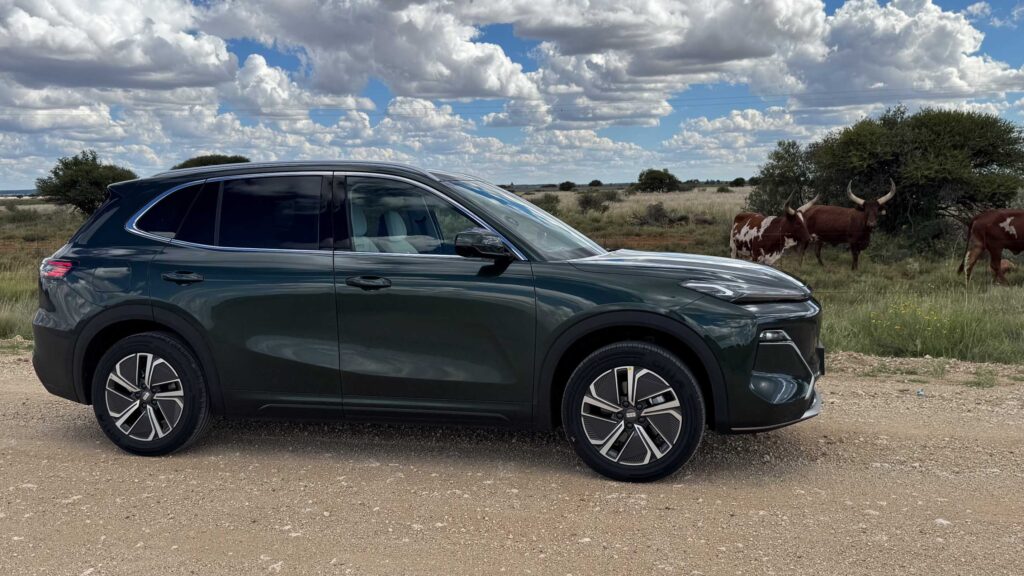
What is the Geely E5 EM-i PHEV?
The E5 EM-i is powered by a 1.5-litre naturally aspirated four-cylinder petrol engine paired with an 18.4kWh lithium iron phosphate battery, driving the front wheels. Combined system output stands at 233 kW (73kW from the combustion engine and 160kW from the electric motor), while total torque peaks at 387Nm. Practicality is equally well considered, with a generous 528 litres of luggage capacity.
The Experience: Real Roads, Real Distances
From 12 December 2025 to 7 January 2026, the E5 EM-i covered just over 4 000 kilometres across three provinces: Gauteng, Limpopo and the North West. It was a proper South African test — long highways, imperfect surfaces and wide-open distances.
Charging proved refreshingly accessible. From DC fast chargers at The Pantry Mercedes-Benz station in Rosebank and outside the ANEW Hotel in Roodepoort, to mall-based chargers in Gauteng and Zero Carbon Charge’s off-grid solar station near Wolmaransstad in the North West, the experience was seamless. A typical DC charge averaged around R120, delivering roughly 105 kilometres of pure electric driving. Over the month, I spent R615 across five charging stations.

A full tank of petrol cost about R750 and delivered close to 895 kilometres. Combined, that meant a range exceeding 1 000 kilometres — freedom without anxiety. Fuel consumption averaged 5.2 litres per 100km, while energy usage settled at 2.1kWh per 100km. This is not future mobility theory; it is a present, workable South African reality.
Ride Quality and Road Manners
Comfort is where the E5 EM-i quietly excels. The MacPherson front suspension and multi-link rear setup absorbed uneven road surfaces with composure, while the 18-inch Giti tyres contributed to an impressively supple ride. At times, it felt like a more affordable, slightly larger cousin to the Volvo EX30.

Driving modes allowed the car’s personality to adapt to the moment. Pure mode delivered serene, fully electric progress; Hybrid mode intelligently balanced energy use for efficiency; and Power mode brought petrol and electric propulsion together for confident overtaking and highway cruising.
Design: Inside and Out
At a glance, you might mistake the E5 EM-i for a certain compact luxury SUV from Stuttgart (namely, the Porsche Macan). My test car, finished in Jungle Green metallic with an ivory white interior, struck a confident and contemporary pose.

The front is defined by a layered LED headlight signature comprising 264 precision-engineered light beads, illuminating up to 184 metres ahead. Aerodynamic sculpting isn’t merely aesthetic; it serves efficiency. At the rear, a 2 240mm full-width LED lightbar, housing 368 individual light beads, reinforces the car’s futuristic identity after dark.
Inside, the E5 EM-i Apex feels thoughtfully curated. Highlights include a 15.4-inch infotainment screen running Geely’s Flyme operating system, a 10.2-inch digital instrument cluster, a high-definition surround-view camera system, wireless Apple CarPlay (with Android Auto arriving via over-the-air update in Q1 2026), and a 16-speaker Flyme premium audio system. A panoramic powered sunroof, a 13.8-inch head-up display, ventilated front seats, driver memory, a power tailgate and 256-colour ambient lighting elevate every journey.

One feature stood out above the rest: the fully reclining front passenger seat. With the headrest removed and the seat laid flat, it transforms into something akin to a business-class bed or lounge, perfect for genuine rest while your co-driver carries on.
Final Verdict
Expectations are understandably high for Geely in South Africa’s evolving mobility landscape, and the E5 EM-i feels like the opening chapter of something meaningful. It is a convincing option as a business runabout or family companion, offering a rare blend of efficiency, comfort and technology at its price point.
There were minor irritations: the radio struggled at times to hold certain frequencies, and the semi-square steering wheel may divide opinion. Yet these are small blemishes in an otherwise compelling package.

Competition is fierce, with rivals including the Leapmotor Range Extender EV, Jaecoo J7 SHS, and Haval H6 PHEV. It also presents a credible stepping stone for buyers aspiring to models such as the Mini Aceman, BMW X3 PHEV, Omoda C9 PHEV, Chery Tiggo 9 PHEV and Lexus NX PHEV.
Ultimately, the Geely E5 EM-i represents outstanding value — challenging established names while making advanced electrified mobility attainable for South African consumers.
Pricing, Service Plan and Warranty
Pricing starts at R679 699 for the Geely E5 EM-i PHEV. This includes a complimentary wall-box charger, R5 000 in public charging credit, a six-year / 150 000km service plan, and an eight-year / 200 000km battery warranty.