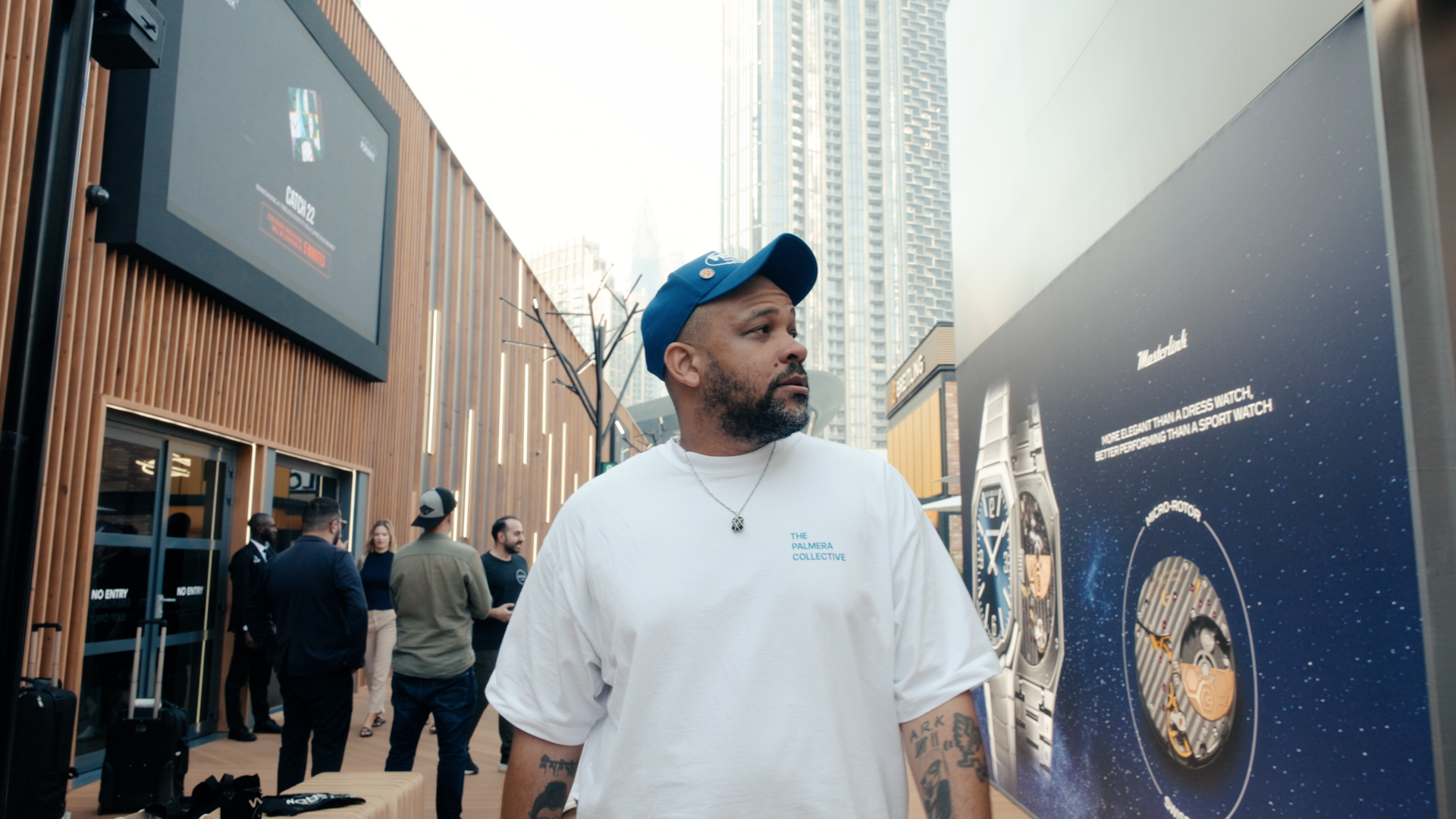
Watch enthusiasts with full diaries should already be planning for Dubai Watch Week in November 2027. Last year’s edition, marking the 75-year legacy of Ahmed Seddiqi , founder of the Seddiqi family business, was so successful that the next event was announced almost immediately.
There is no mistaking Perri Dash’s enthusiasm when he recalls his visit. “It was awesome,” he says, repeating the phrase with emphasis, as if still slightly surprised by the scale and energy of the experience.
What stood out most to Perri was not only the increase in visitors, but the way the event has evolved into a cultural moment — one collectors actively plan their calendars around.
“It’s become an event,” he explains. “Collectors and enthusiasts now plan for it.”
Extended opening hours and a dense calendar of dinners, parties, and excursions turn the week into a continuous social exchange. “Once 10pm would hit, there’d be parties, dinners, excursions, boat rides — you name it. Everyone was out.”
Dubai and the Rise of the Collector
In Perri’s view, what distinguishes Dubai Watch Week from Watches and Wonders and even Geneva Watch Days, where everything feels more structured, is its openness. Dubai feels fluid, communal, and disarmingly accessible, even as major industry figures participate.
He points to the presence of Rolex CEO Jean-Frédéric Dufour on a panel as a telling signal. “That’s pretty rare,” Perri notes. “It does seem like the larger brands are making more of a concerted effort to engage the community.”
Yet for all the heavyweight names in attendance, Perri is unequivocal about where the real energy lies. “The biggest players at Dubai Watch Week were the independent watchmakers,” he says. “That’s who everyone was most interested in.”
Legacy brands have responded with increasingly elaborate activations — Audemars Piguet’s purpose-built house being a prime example — but the gravitational pull has shifted. “They’re having to work a little bit harder to keep up with all the excitement surrounding independent watchmaking.”
That excitement is amplified by Dubai itself. Perri describes the city as “probably the friendliest watch city in the world.”
“The pieces people brought out because they could actually wear them,” he says, almost incredulous. Reserved collectors appeared in gem-set, audacious pieces they would never risk elsewhere.
“When you arrive in Dubai, there’s an extra level of safety,” Perri explains. “You can leave your watch on a table, walk away, and come back — and it’s still there.”
That perception, anecdotal or not, changes how collectors engage with watches and one another.
“They really felt like they were in a watch city… part of a real watch culture. And they didn’t have to worry about anything.”
Independents vs Heritage
This sense of community feeds directly into one of the most persistent debates in contemporary watchmaking: innovation versus inertia.
Perri is clear that collectors are no longer satisfied with rhetoric. “People are more concerned with genuine innovation,” he says.
For too long, he argues, large brands have leaned on heritage and perceived scarcity — whether through restricted production or retail bottlenecks — rather than meaningful progress.
By contrast, independents are setting the agenda. He cites H. Moser & Cie. as a benchmark, for engineering advances and confidence in design.
Independent watchmaker Max Büsser, too, commands an almost celebrity-like presence. “When certain watchmakers appear, you could liken it to Jay-Z and Beyoncé entering a room,” Perri says. When he comes out and everyone gathers around, it’s serious.”
Jacob & Co., a brand often polarising in more conservative circles, earns Perri’s unambiguous respect. “I personally love Jacob,” he says. “His company is incredibly innovative.”
In Dubai, where expressive design thrives, the brand’s bold language resonates. “To have a Bugatti Chiron Tourbillon on your wrist — you’re not going to see that in New York, but you’ll see it in Dubai.”
Scarcity, Credibility and Awards
The question of limited editions inevitably follows. Perri does not believe collectors reject the concept outright; rather, they object to its misuse.
“They understand how it’s being used,” he says. “Many don’t appreciate when it’s used purely as a selling point — a faux scarcity plan to make me feel I have to jump.”
He contrasts this with Blancpain’s recent Double Grande Sonnerie Perpetual Calendar Tourbillon. The project took eight years to develop, and each watch is made by a single watchmaker from start to finish, limiting production to just two a year.
Crucially, Blancpain has not labelled it a limited edition. “That says a lot about the mentality,” Perri observes.
While the watch has four gongs and plays two melodies, it remains robust and wearable. For Perri, this is how major brands should respond to the independent movement.
“You can’t fake the funk with these guys,” he says. “Just saying ‘limited edition’ for the sake of it is a disservice — not only to the community, but to your brand.”
Regarding awards, particularly the GPHG, he urges perspective. “If you look at what LVMH is doing right now, you have to give credit where it is due.”
From the revival of Daniel Roth to collaborations with Kari Voutilainen, he believes the group is responding intelligently to collector values. “If you removed their label from some of these watches, you’d still say: that’s a hell of a watch.”
As a GPHG Academy voter, Perri says judging requires detachment. “You have to remove the brand from the equation as much as possible and judge on the merit of what is produced.”
Not all outcomes align with his personal taste, but he views awards as reflections of broader cultural currents. “It shows you where the collector community is going,” he says.
Pricing and Access
More broadly, Perri believes the globalisation of events — from Geneva to Dubai — signals something deeper.
“There’s something special going on in the watch world right now,” he says. “It’s still growing.”
Looking ahead, he anticipates continued investment in precious metals, driven by margins and tariffs, alongside smaller production runs. Yet he also warns of an expanding gap.
“There’s a segment of the watch community that’s getting priced out.”
He cites the Royal Oak in stainless steel as an example, now starting at $30 000, almost double its price a decade ago. “In another two or three years, it could be on its way to being a $40 000 watch.”
In this environment, accessible independents become vital. Brands like Studio Underd0g, Christopher Ward London, Atelier Wen, and others are creating passion-led communities around attainable price points.
Ultimately, Perri’s perspective as a self-described “professional wristroller” is grounded in observing wrists, rooms, and reactions. In an increasingly discerning market, authenticity has become the watch world’s most valuable currency.