

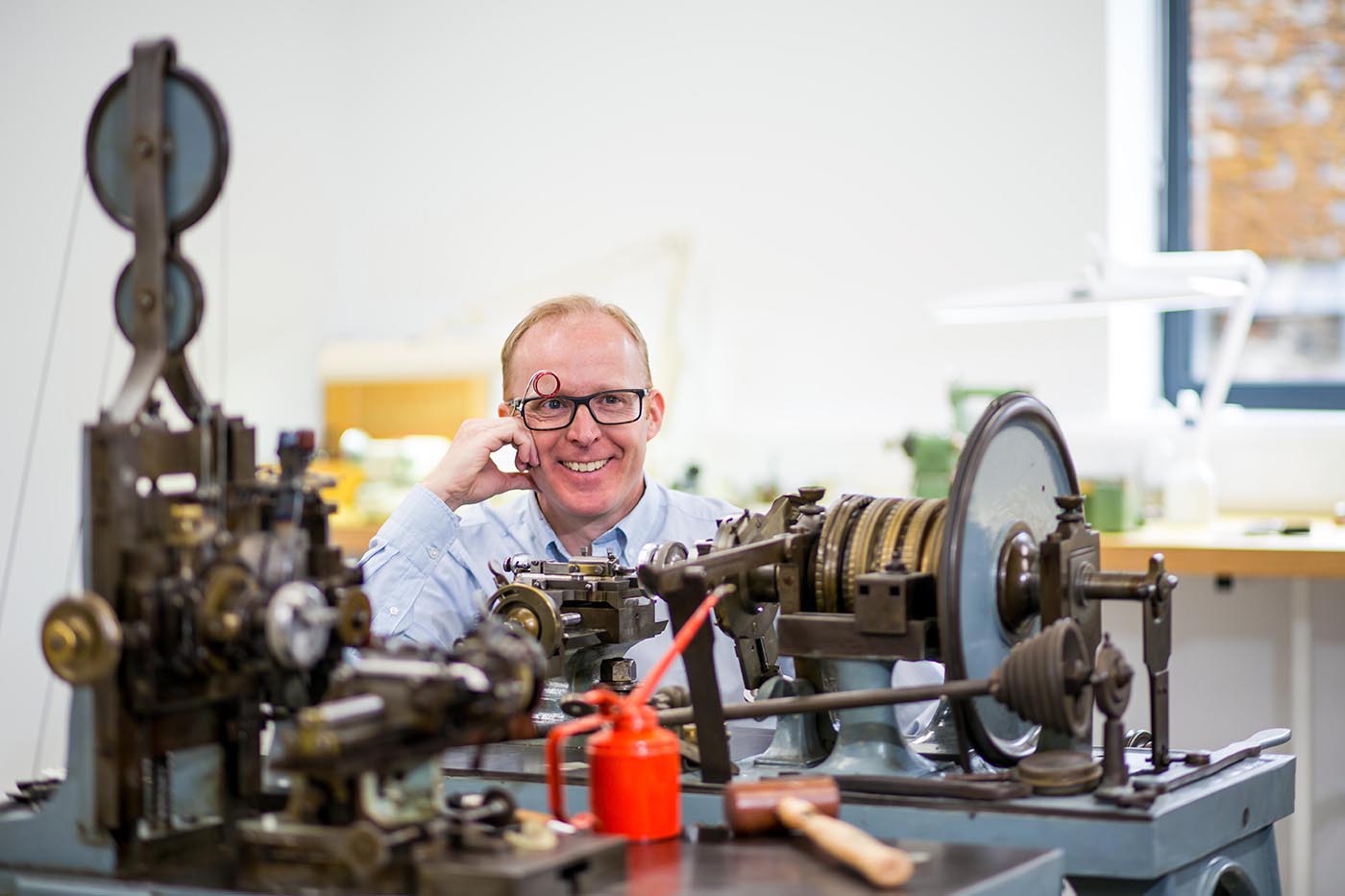
Look up the word “flawless” in a dictionary, and all it should say is “RW Smith”. Smith’s late mentor, George Daniels, might concede, “Job done” in response to this comment on social media.
Legendary watchmaker Dr. Roger W Smith OBE headlined auction news two years ago (10 June 2023) when Pocket Watch No. 2 went under the hammer at Phillips in Association with Bacs & Russo in New York, shattering records for any British-made timepiece. The final bid, a jaw-dropping $4.9 million, marked not only the highest price ever for a British watch but also a triumphant landmark for independent horology.
Roger himself attended the auction — and weeks before, shared a detail on Instagram that underscored the watch’s enduring brilliance: “running in perfect order… amplitude as lively as the day [I] completed its build 26 years ago — and without a service in all that time!” His understated pride struck a chord, blending masterful craftsmanship with quiet confidence.
Roger later reflected on this milestone in his horological journey, hoping it would also be a meaningful statement for British watchmaking.
That sentiment, echoed by Phillips’ Americas Head of Watches Paul Boutros, who hailed the watch as “the cornerstone of modern British watchmaking”, points to something far bigger than a single auction result. “With its clear influence by… George Daniels, alongside aesthetic details distinctly Roger’s own,” the watch captivated audiences during its world tour through London, LA, Geneva, Hong Kong, and New York.
George, Roger, and the Escapement Revolution
To understand the profundity of Roger’s achievement, one must look to George Daniels, the titan of British watchmaking in the 20th century. Born into difficult circumstances, George encountered a pocket watch whose precise, self-contained wonder captivated him. As one biographer recounts, he dismantled a household alarm clock “driven by intense curiosity” at its capacity to function independently without outside help, regarding it as a reflection of his own view of life.
“There’s nothing more attractive than a good watch. It’s historic, intellectual, technical, aesthetic, amusing, useful. You couldn’t beat it. It covers every field. And supplies a living for hard-up watchmakers like me,” he said in an interview.
George’s breakthrough came with the invention of the coaxial escapement in 1974 — the first major innovation in mechanical watchmaking in 250 years. This invention significantly reduced friction compared to the traditional Swiss lever escapement, improving long-term accuracy and reducing the need for lubrication. “There is now no rubbing action… It’s just like [gently] pushing open a gate. No friction involved,” said George. He spent several years refining it, sparking a revival in craft horology. It was industrialised by Omega, which began incorporating it into their watches in 1999, making them the first brand to mass-produce a mechanical watch with a coaxial escapement.
George had an unwavering belief in craftsmanship. “I never made a watch for commercial reasons. They were always handmade for specific reasons, which improve the performance of the watch,” he said. Finish and elegance were just as critical: “The most important aspect of a watch is to get the aesthetics right.”
Roger’s Journey: From Garage to Greatness
Enter Roger W. Smith, the proud protégé George once taught, imparting technique and the wisdom of relentless perfectionism. Roger’s story begins in his father’s garage and a Manchester college workshop that transformed his future. “My first day at college was really my best day of education ever… my life started at that point,” he recalls.
Guided by George, Roger spent years refining a pocket watch in isolation, applying an intense and solitary discipline that tested his resolve. His perseverance startled onlookers: evenings spent remaking minute parts lost on workshop floors were attributed not to talent, but to “an abnormal degree of patience”.
His breakthrough came after seven years of near-obsessive dedication. Roger recalls the moment George finally acknowledged his mastery: “He opened the back… held it in his hand … [then] he said ‘congratulations, you’re a watchmaker.’”
Soon after, George invited Roger to the Isle of Man’s “Millennium Project” in 1999, entrusting him as a collaborator. Their dynamic was intense — long days, precision teaching, and mutual respect. George, well on the cusp of legendary status, put Roger to the test repeatedly: “Go away and finish it properly. It’s all about finish,” he said. Roger responded with those exacting standards — never selling out, never compromising.
Impact on the Industry and Beyond
In a market long dominated by Swiss giants, Roger and George represent a renaissance of handmade, entirely in-house watch production. Roger honours George’s legacy but doesn’t imitate it. His creations are built to reference classical design yet breathe modern life into age-old artistry. George believed you should never see the hand of the maker in any mechanical object. That philosophy resonates today.
Moreover, each component must be extraordinary. Tiny bevels hand-finished so smoothly that light glides across them. Cases assembled with the kind of subtly graceful curves that feel inevitable. Levers, wheels, dials — made without compromise.
As George put it, “Elegance is supreme… no trouble in selling the watch once you’ve got the aesthetics right.” Again, Roger has taken that principle and coded it into every cog and plate.
Pocket Watch No. 2’s stratospheric sale not only testifies to market value, but it also signals cultural value. It shows that in a digitally distracted age, there’s still space for analogue, tactile devotion to craft and tradition.
A Renaissance in British Craftsmanship
Roger’s roadmap includes not just individual creations, but community and legacy. He has expanded his workshop and is mentoring new watchmakers — not to create Swiss clones, but to foster a micro-community of high-craft, small-scale excellence on the Isle of Man.
In a 2021 survey, over 100 British watch brands expressed a desire to bring production home, and firms are sharing knowledge with newfound strategic intent. The momentum is building. From George’s coaxial revolution to Roger’s $4.9 million pinnacle, the message is clear: British watchmaking is not merely back — it’s setting the world’s tempo. Each tourbillon, each hand-engraved plate, each hand-polished bevel is a statement: time, properly measured, is worth comprehending all over again. And in that realisation, we find something truly flawless.


