Africa’s beauty industry has long supplied the world with some of its most precious raw ingredients, yet the narrative has too often been written elsewhere. And while the sector remains largely female-driven, a new generation of male entrepreneurs is reshaping the story — building brands rooted in heritage, sustainability, and community empowerment. They’re not merely building businesses — they’re rewriting narratives around beauty, masculinity, and African identity.
Meet the four men whose work is redefining what it means to create beauty products with African DNA.
Julian Boaitey: Ethical Beauty Across Continents
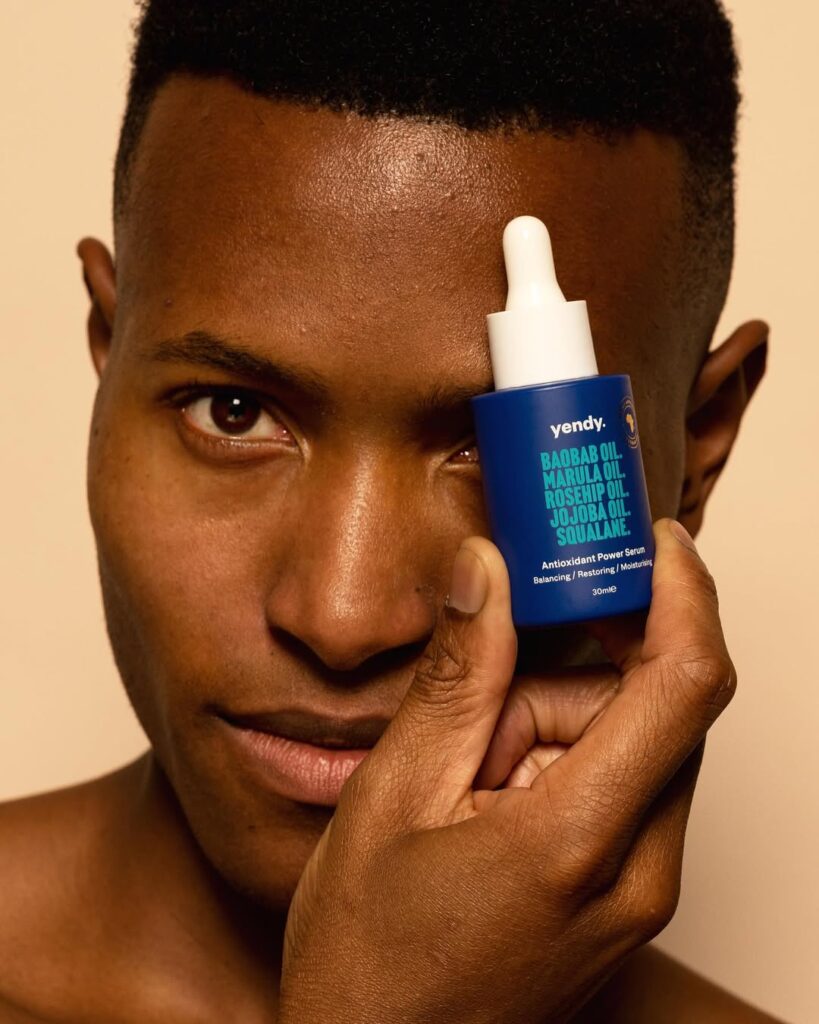
At just 32 years old, British-Ghanaian entrepreneur Julian Boaitey has established himself as a powerful voice at the intersection of African heritage and global beauty. As founder and CEO of Yendy Skin, a London-based brand launched in 2021, Julian has built a business model that prioritises transparency and direct trade long before they became industry buzzwords.

What sets Yendy apart is its operational footprint in Northern Ghana, where Julian spends considerable time working directly with small-scale female farmers who cultivate superfood ingredients such as shea butter, baobab, and moringa. These collaborations are a fundamental pillar of the business. By ensuring these women receive fair compensation and recognition, Julian challenges the extractive practices that have historically defined the relationship between Africa and the global beauty industry.
Julian’s entrepreneurial instincts, heavily inspired by his father, emerged when he was a young boy growing up in Ghana. His first venture involved selling shea butter sourced from his mother’s home to family and friends, laying the groundwork for a brand that’s now celebrated in the pages of British Vogue and Harper’s Bazaar. Last year, he was named one of the Top 25 Black Entrepreneurs to Watch in 2025 by the UK Black Business Show and HSBC, proving this African beauty mogul is only getting started.
Olowo-n’djo Tchala: The Return of a Social Enterprise Pioneer

Few stories in African beauty are as compelling as that of 49-year-old entrepreneur Olowo-n’djo Tchala from Togo, whose journey from poverty to prominence embodies purposeful business. Born in the village of Kabole, Olowo-n’djo left school after the sixth grade to support his family, never imagining he would one day build one of the largest skincare brands in the United States.

In 2003, after relocating to America, Olowo-n’djo founded Alaffia, a fair-trade personal care brand built on a simple premise: that beauty products could serve as vehicles for social change. For two decades, Alaffia sourced shea butter, coconut oil, and other ingredients from women’s cooperatives across West Africa, ensuring fair wages and funding community projects, including maternal health services, schools, bicycles for students, and reforestation efforts in Togo.
In late 2025, Olowo-n’djo made headlines by buying back Alaffia through Ayéya Inc., a company he launched in 2022. The acquisition represented a homecoming of sorts, allowing him to realign the brand with its original mission of social impact, which he felt had become diluted under outside ownership. Through both Alaffia and Ayéya — the latter focused on artisan goods and fully transparent supply chains — Olowo-n’djo continues to demonstrate that beauty brands can advance gender equality and environmental sustainability while competing at the highest levels of the global market.
Stuart Berry: Changing Men’s Skincare in South Africa


In Cape Town, Stuart Berry identified a gap in his home market that few had considered addressing. The 43-year-old co-founder of FACE for Him, alongside his wife Camilla, launched South Africa’s first premium skincare range developed exclusively for men in 2021, after realising that local men had few options tailored to their needs.
Stuart brought extensive experience to the venture, having spent years as a brand director and marketing manager. But FACE for Him was built on a much simpler insight: men want effective skincare without the overwhelm of complicated routines or excessive choice. His research revealed that most South African men still rely on their partners for skincare advice, which he saw as an opportunity for education and guidance.
The brand’s philosophy is rooted in speaking directly to men in language they understand. Signature products like the Prebiotic Face Wash and the Moisturiser SPF50, formulated to protect against UVA, UVB, blue light, and infrared, are designed for efficacy and accessibility. Beyond his role as co-founder, Stuart also contributes regularly to the brand’s blog, demystifying topics like antioxidants and hyaluronic acid.
His mission is clear: to bring premium, affordable skincare made with pride in South Africa, and to change the game for men’s self-care. And he’s well on his way to achieving both.
Craig Noik: Championing Indigenous African Botanicals

From his base in Los Angeles, South African expatriate Craig Noik has spent over a decade bringing the botanical riches of his homeland to the world. Alongside his wife Julia, Craig founded African Botanics in 2012 as an ode to the landscapes and traditions of his childhood, combining indigenous African plants with modern skincare technology to create high-performance products that also honour ancestral wisdom.

After relocating to the United States in 1997, he spent more than a decade as a creative director and owner of an advertising agency. Yet the pull of his heritage proved stronger. During travels in South Africa, the Noiks fell in love with the regenerative properties of marula oil, used for centuries in traditional beauty rituals, and the idea for African Botanics was born.
Today, the brand is renowned for its Pure Marula Oil and formulations that draw on rare, resilient plants from South Africa’s diverse ecosystems. Most importantly, all products are developed and manufactured in South Africa, supporting rural communities and preserving biodiversity. This dedication to supporting locally goes beyond just the ingredients — it’s about fair trade and what Craig calls “rural upliftment”, making sure the communities behind the harvest benefit from the brand’s success, too.
Last year, the Noiks expanded their portfolio with the launch of Osmé Parfum, a fragrance line that draws on elemental and mystical influences to support mood and energy. For Craig Noik, both brands represent the same ethos: preserving African tribal wisdom while presenting it in forms that resonate with contemporary consumers.