


Lesotho aka The Mountain Kingdom has a bounty of cultural riches including a fascinating cross-pollination of histories, a highly distinctive sound of music, breathtaking beauty, and the celebrated art of the Basotho blanket. Thanks to a jewel of an exhibition on view at Sanlam Art Lounge in Sandton titled ‘Sutha ke Fete’ meaning ‘Make way so I may pass’ – the public has an opportunity to look at the blankets more closely. The exhibition showcases the meticulously researched origins, designs, production, and symbolic meanings of the Basotho blanket, along with texts exploring its role in Lesotho’s national identity and contemporary cultural practices. You’re invited to explore (and wear) these cultural treasures, but remember to bring your ID for entry, as the venue is, after all, a bank.
‘Sutha ke Fete’ at Sanlam Art Lounge ends on 25 January 2025.


— Fashion designer Thabo Makhetha’s ‘Blankets of Prestige’ creations are sold at clothing stores.
The Basotho blanket is so much more than just a warm, thick weave blanket: this wearable art tells stories of layered modernity and history in an African context, offering a bridge to the Basotho past, present and future told in bold neo-pop graphic designs that feature a mix of the sacred and profane, deeply symbolic, often symbolising fertility and growth. There is a blanket for the shepherd, as well as one for brides, initiates, mothers-to-be, weddings, and even for the afterlife.
With designs featuring indigenous spiral aloes (found only in the Maluti mountains), iconic Basotho hats and shields, mealie cobs, crowns, diamonds, mythological lizards, celebrated monarchy, spitfires, Eiffel Tower, coins, flames, and leopard spots, for starters. With a historical development worthy of a cultural studies course, it is no surprise that academics and institutions seem to agree: 2025 promises a colloquium on the history and influence of the Basotho blanket, set to take place in Cape Town at UCT’s Center for African Studies that aims to trace the garment’s role within the Basotho diaspora, focusing on its cultural, symbolic and functional uses, even its transformation into a symbol of identity and resistance.


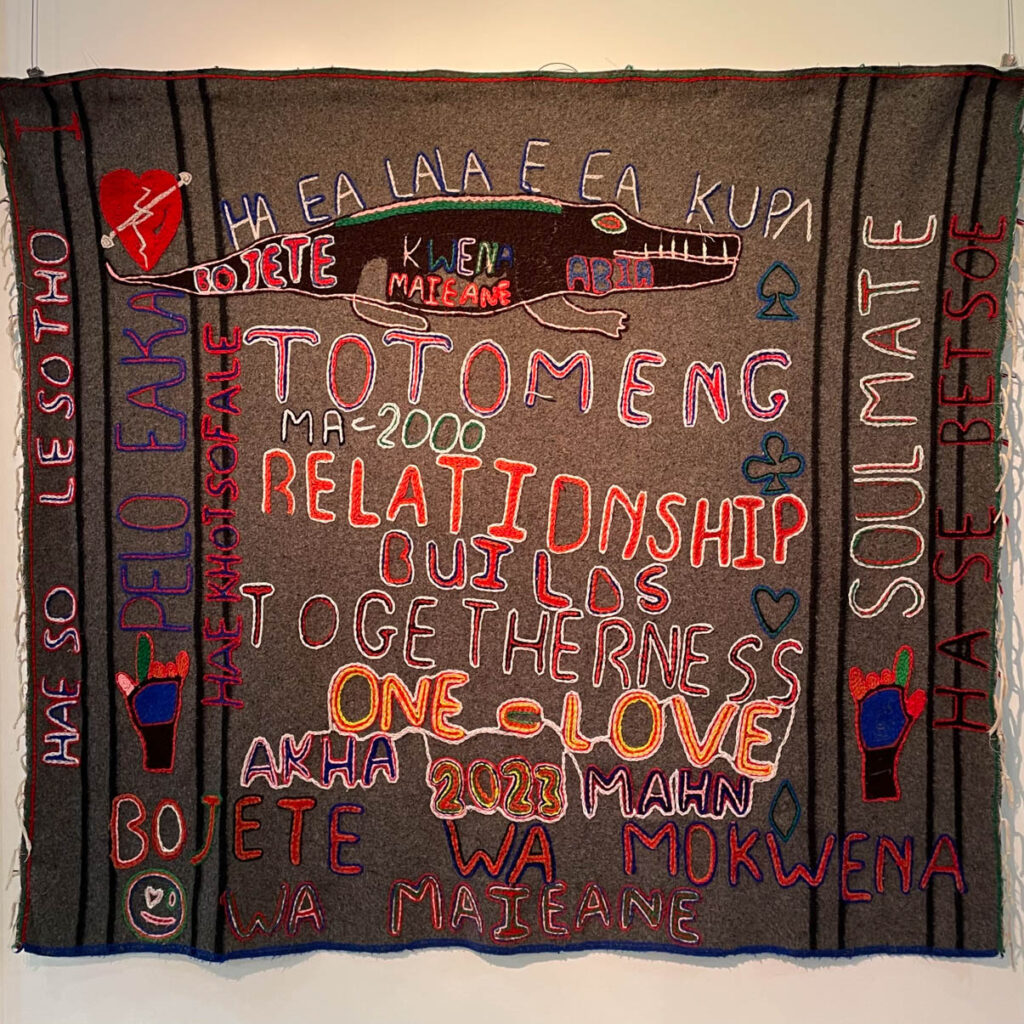
Sanlam Art Collection Curator Stefan Hundt and Co-Curator Steven Sack sourced a mix of rare wool heritage blankets and contemporary traditional blankets. Explaining to me how the blankets are intended to be worn, not made for beds or walls. “Indeed, they are for wearing and they look quite different when worn. Men pin the blanket on the shoulder much like a toga, whilst women would pin them in the front symmetrically, This changes the way one sees the design. Also, women would wear the lighter side of the blanket facing outward. However, the blanket is usually seen in full view when being purchased.”


The point of purchase for these blankets also carries an intriguing connection to the history of retail in Southern Africa. In 1872, trading stores were granted licenses to sell these blankets. Fast forward to today, and Aranda Textile Mills manufactures the majority, with direct orders available from them. “The blankets such as the contemporary Diaspora Diamond, part of Aranda’s Young Designers Collection are limited editions and sell out quickly. So, when shopping online, bear in mind if a design is popular and sells out, Aranda will make another batch which usually happens about six months after the stock has sold out. December is initiation season in various parts of the country which means demand peaks in December,” says Hundt.

Timelessly practical and steeped in history and symbolism, the iconic Basotho blanket never goes out of style. In fact, it would be hard to find a more precise example of wearable art in the global south, with every stage of living deserving a blanket of prestige.
Images courtesy of :
© Matthew Barac
© Sanlam Art Collection


