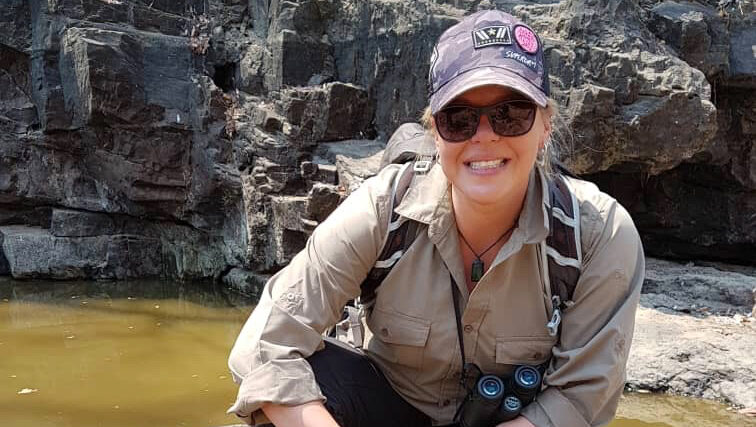
It started with a number: 96 elephants poached every day in Africa. Holly Budge was a masters graphic design student when she read it, and she couldn’t put it down.
“I thought, ‘I want to use my skills to come up with a fresh awareness campaign’,” she says. “Something non-gory, non-political. Something that could reach people who don’t want to see gruesome images but still need to feel the weight of this.”

What she built was How Many Elephants – a charity, a travelling exhibition, and a necklace of 96 elephants cut in vegetable ivory, one for every elephant lost each day. But the moment that changed everything came later, when she heard about a team of women in South Africa called the Black Mambas – the world’s first all-female anti-poaching unit.
She reached out. They already knew her work. They said, “When are you coming to see us?”
She went. She was thrown straight into a night patrol. She never quite left.
Thirteen years on, Holly works with around 6 000 female rangers across the world – and the case for female rangers is no longer just moral. It’s measurable.
Less than 11 per cent of the global ranger workforce is female. The world is 1.5 million rangers short of the 30×30 target – protecting 30 per cent of all land and ocean by 2030. Roughly 750 000 of those missing rangers should be women. And the evidence for why that matters is unambiguous.
More Than Conservation

“No one could have foreseen just how successful female rangers would be on the frontline,” Holly says. “Not only are they incredible protectors – they’re proving to be very successful as educators, role models, and beacons of hope. They’re changing attitudes towards the role of women, not just in their communities but around the world.”
Women invest 90 per cent of their income back into their families. Rangers who were once struggling are now buying land, building houses, and sending children to school. In 13 years, not one of the Black Mambas has failed a lie-detector test. The work is physically demanding, often dangerous, and female rangers are not only meeting that standard – they are raising it. They are building the community trust that conservation ultimately depends on, using conversation as much as enforcement, showing up differently, and staying longer.

One story above all others has stayed with Holly. A young Maasai woman called Caren joined the Mara Elephant Project at 19, placing in the top 1 per cent of all recruits – men and women. By 21, she was leading a mixed team, with men in their 50s deferring to her completely.
Holly asked about her family. Caren had a one-year-old daughter at home. When she visited, she pretended to be an aunt or sister – the child was too young to understand.
“That pulls at your heartstrings,” she told Holly. “Going home and your baby doesn’t know you’re mummy.”
Caren is now the family’s sole breadwinner. Even if she wanted to step back, she can’t.
Growing a Global Movement

“These women humble me every single day,” Holly says quietly. “They have overcome huge challenges, huge adversities – and yet they’re still smiling, still out there, still doing it. I think we can all learn a lot from them.”
World Female Ranger Week, now in its sixth year, exists to make the world see what Holly sees on the frontline. It has reached more than 500 million people. Six governments support it. This year, it goes live in Zambia in collaboration with The Nature Conservancy, with more than 100 female rangers expected to gather in Kafue National Park for skills workshops alongside forensic experts and One Health specialists.
Not a rally. Not a photo opportunity. Real, practical things.

“It’s got to be useful,” Holly says. “I don’t want people to feel overwhelmed, apathetic, or sad. I love sharing stories of hope – and these women’s stories are exactly that.”

The ambition behind the week is significant. How Many Elephants is looking to raise $2 million to recruit, train, equip, and deploy 20 new female ranger teams (200 rangers) across Kenya, Tanzania, Zambia, Zimbabwe, Uganda, and South Africa.
The infrastructure is there. The partners are there. The rangers are there. What’s missing is the funding to reach them.
There are many ways to get involved – from donating to amplifying the campaign online, from nominating a ranger for the World Female Ranger Awards to joining Holly on the frontline in person.
She calls it experiential philanthropy: small-group trips to South Africa with the Black Mambas or to Kenya with the Mara Elephant Project, where participants see the impact of conservation firsthand.
“I want people to come and see this work. To feel it. That’s when things change.”

When asked who she’d take on one of those trips if she could choose anyone in the world, she doesn’t hesitate for long.
“Michelle Obama. She has incredible warmth, incredible wisdom. Her mission is to inspire women and girls to think big and dream bigger. I reckon she’d get stuck in.”
A pause, then a laugh.
“It’ll probably never happen. But I’d love for her to see what these women are doing.”
So would we all.

- World Female Ranger Week runs from 23–30 June 2026.
- Visit worldfemalerangerweek.org to donate, share, nominate a ranger for the World Female Ranger Awards, or find out more.
- Wildlife Positive Travel experiences: wildlifepositivetravel.com
- How Many Elephants: howmanyelephants.org
- Holly Budge: hollybudge.com