

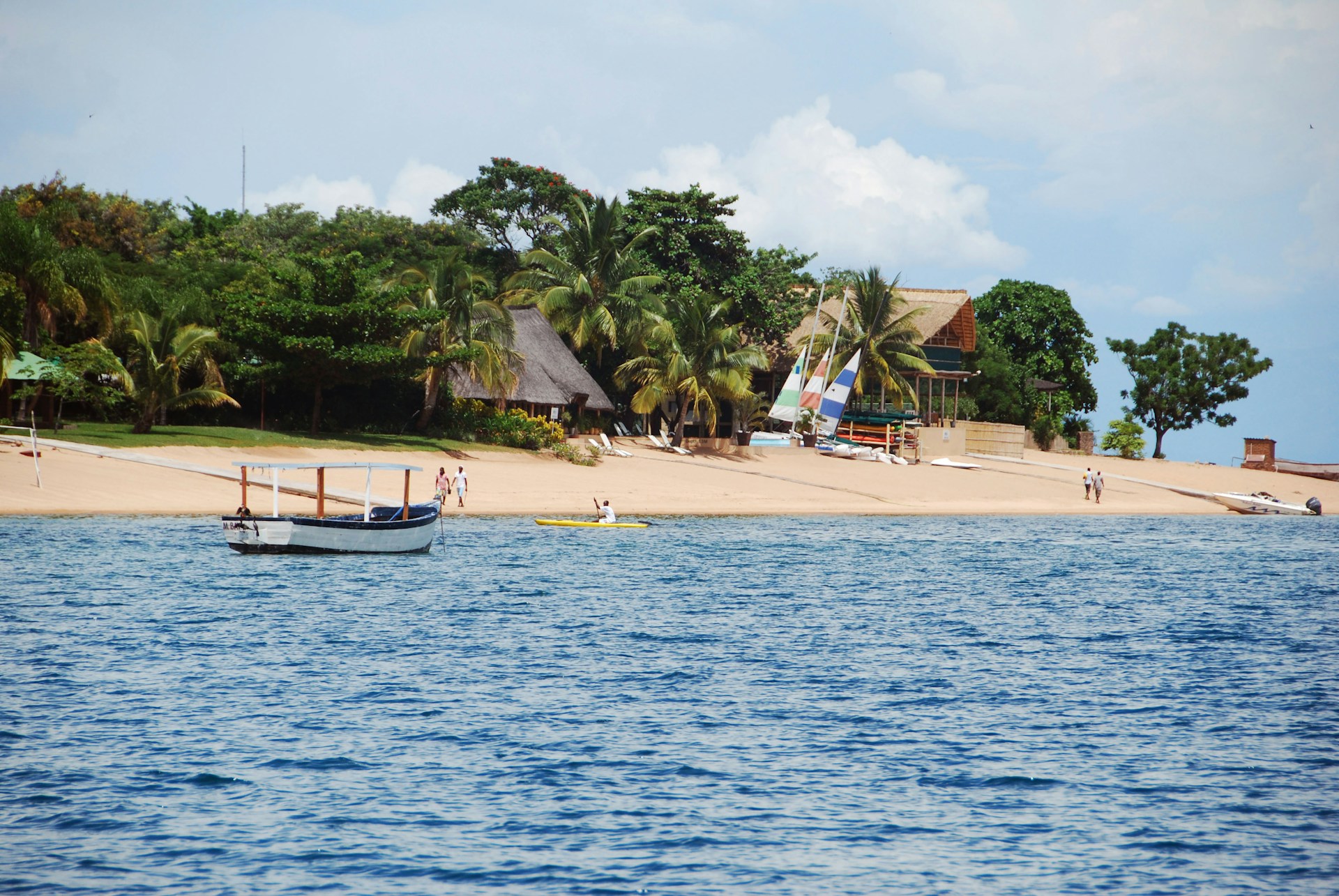
With its tide-free waters, island rhythm, and emphasis on low-impact luxury, this freshwater coastline offers a refreshing new perspective on the beach holiday.
A Different Kind of Beach
We’re all a bit bored of the Indian Ocean clichés; the overwater villas; the infinity pools competing for attention; the curated perfection designed for Instagram.
Perhaps it’s time to step into water so clear and still that it feels like a natural swimming pool, stretching endlessly into the horizon?
No tides. No swell. Just quiet.
At Lake Malawi, the experience is immediate and disarming. This vast freshwater lake offers a beach escape that feels both familiar and entirely unexpected. The water is calm, swimmable, and inviting in a way ocean beaches rarely are, allowing for long, uninterrupted immersion.
That’s part of what makes the destination so distinctive. As Joseph Nkosi, PRO at Malawi’s Department of Tourism, puts it, Lake Malawi offers “a unique, tide-free experience” that is “exceptionally comfortable for extended swimming and family-friendly water sports.”
Where Barefoot Meets High-End
There are no rows of identical villas or rigid resort structures. Instead, there is space — both physically and emotionally — to settle into this place. The appeal is less about checking into a resort and more about feeling connected to the landscape, the lake, and the rhythm of daily life around it.
Mike Varndell, Founder & CEO of Crafted Africa, describes Lake Malawi as “real, raw, and refreshingly unpolished”, adding that it offers “a quieter, more authentic kind of luxury.” That idea runs through the experience here. Your day becomes less about spectacle and more about freedom, simplicity, and authenticity.
Or, as Mike neatly puts it, it is “where barefoot meets high-end”. It is a line that captures Malawi well: high-touch without being overdone, thoughtful without feeling managed, and beautiful without being boringly over-curated.
Life on Likoma Island
On Likoma Island, this philosophy takes shape in a way that feels both effortless and deeply intentional.
At Kaya Mawa, days unfold without urgency. Morning coffee arrives as the island wakes. Fishermen move quietly across the water. Sandy paths replace paved roads, and daily life continues around you rather than being staged for you.
Guests often arrive expecting a traditional beach escape; salt in the air, rolling tides, the familiar rhythm of a resort. What they find instead is something quieter, more personal, and far more connected to place. Lauren Summers, Marketing Director at Green Safaris, says, “Most guests arrive picturing a classic beach holiday… Kaya Mawa quietly shifts that idea.”
Here, the lake is fresh, clear, and impossibly calm. You can swim far out with no waves pulling you back, just stillness all around. The island itself deepens that difference. Likoma is not a place built around tourism; it is, rather, a living community, with fishermen heading out at dawn, children cycling past, and local life moving at its own pace.
That sense of belonging shapes the guest experience in ways visitors may not immediately notice. Most of the lodge’s team are from Likoma Island, and that familiarity creates a hospitality that feels natural rather than performative. As Lauren explains, “You are not simply being looked after, you are being welcomed in.”
The details reinforce that feeling, as many local workshops craft the interiors, and community gardens help supply fresh produce. Every day on the island carries a sense of ease, whether you’re kayaking across the bay, cycling through nearby villages, visiting St Peter’s Cathedral, or simply spending an afternoon doing very little at all.
That night, dinner is served under the stars as lanterns light the evening, and the atmosphere is infused with stillness.
Mumbo Island: Back to What Matters
If Likoma represents refined barefoot luxury, Mumbo Island offers its purest expression.
Located within Lake Malawi National Park, the island remains almost entirely untouched. It lies 10 kilometres offshore across open water and has never been inhabited. The camp occupies just one small corner of the island, while the rest remains undeveloped, crossed only by rough footpaths.
Clive Bester, Director of Kayak Africa, says, “On Mumbo Island, Mother Nature provides the wow!” The setting does the heavy lifting here. No roads. No overdevelopment. No pool lined with loungers. Just a small, carefully managed camp in a place that does not need embellishment.
Luxury, then, is best understood as restraint. Or, in Clive’s words, it follows “the philosophy of providing everything that you need and nothing that you don’t.”
Guests do not always settle into it straight away. The lack of constant stimulation can feel unfamiliar at first, especially for travellers used to more traditional beach destinations. But after a day or two, the pace begins to shift. Attention relaxes. Days stretch. By the time departure comes, it often feels premature, as though the experience has only just begun to unfold.
A Living Conservation Story
Beyond mere beauty, Malawi also has a deeply intertwined story of conservation.
Lake Malawi National Park was established as the world’s first freshwater marine reserve, created to protect one of the most biodiverse aquatic ecosystems on the planet. Its waters are host to an extraordinary number of endemic cichlid species, making the lake globally important for biodiversity and evolutionary research.
Joseph Nkosi notes that the park was created “to safeguard the lake’s unparalleled variety of fish, particularly its endemic cichlids”, which makes it a destination with both ecological value and travel appeal. The clear water, thriving fish life, and low-impact approach to tourism are central to the destination’s appeal.
On land, the story is just as compelling. Malawi has undergone a remarkable wildlife recovery in recent years, with restored reserves and the return of the Big Five helping reshape the country’s wider travel offering. This makes the “beach and bush” aspect feel genuinely integrated.
Tourism revenue supports local livelihoods, education, skills development, and long-term environmental stewardship. At Likoma, for example, sustainability is part of how the island works: solar energy, local food production, scholarship initiatives, nursery school support, tree-planting programmes, and community clean-up efforts all form part of a wider, connected system.
The Pleasure of Less Pressure
In a travel landscape increasingly defined by visibility and performance, Malawi offers something quieter.
There is no pressure to document or display. No expectation to participate in a curated version of the experience. Instead, there is space to simply exist within a place that has not been overly reshaped.
For travellers who feel they have already seen it all, that may be exactly what makes Malawi feel new again: not spectacle, but sincerity; not performance, but presence.
Where to Book or Enquire
Featured Stays and Experiences
Kaya Mawa (Likoma Island, Lake Malawi)
- Operated by Green Safaris
- Email: [email protected]
- Website: greensafaris.com
Mumbo Island Camp (Lake Malawi National Park)
- Operated by Kayak Africa
- Email: [email protected]
- Website: kayakafrica.co.za
Travel Specialists & Operators
- Crafted Africa (Malawi Travel Experts)
- Email: [email protected]
- Website: craftedafrica.com


