Rado’s roots date back to 1917, but its reputation for materials innovation was forged in the late 1950s and early 1960s, when the company set out to create a watch that could better resist everyday wear.
The search first led to hard metal (tungsten carbide), used for the original DiaStar. It delivered the scratch resistance Rado wanted but added considerable weight. The next challenge was to find a material that was equally durable and far more comfortable on the wrist.
That search eventually led to high-tech ceramic. Introduced in 1986 through the ceramic bracelet components of the Rado Integral, the material would become central to the brand’s identity and later reinforce its reputation as the “Master of Materials”.
High-tech ceramic bears little resemblance to domestic ceramic. It’s an engineered material made from fine mineral powders and binders, which are injected into moulds under pressure before being sintered at 1 450°C. During firing, the components shrink to their final dimensions and develop their colour.
The finished material is lightweight and highly scratch-resistant. Rado’s high-tech ceramic is five times harder than stainless steel, which explains why a well-worn ceramic watch can retain its appearance for years.


Producing it is considerably more demanding than working with steel. According to Rado, a ceramic case can take between 29 and 35 days to complete, compared with roughly 12 hours for its steel equivalent. Simply creating the material can take five to six weeks. Components must be moulded, fired, machined, and polished before final assembly at the company’s headquarters in Lengnau, Switzerland.
Polishing alone can take seven days. Because the material is so hard, ceramic components are placed in a large vessel with water and other ceramic pieces, where constant movement gradually produces the required finish.
This sustained focus on materials has distinguished Rado for decades. While much of Swiss watchmaking centres on movements and complications, Rado has often looked to the case and bracelet as sources of technical innovation.
Its work with colour offers another example. What began with black-and-white ceramic has expanded into a palette of more than 20 shades. Producing consistent results from one component to the next requires tight control throughout the process, particularly since the final colour only emerges during firing.
The appeal is not confined to appearance. Ceramic is significantly lighter than steel, hypoallergenic, and quick to adapt to the wearer’s skin temperature. It feels smooth and warm on the wrist rather than cold to the touch, an aspect that becomes more apparent when the watch is worn than when it’s admired in a display case.
To mark the anniversary, Rado has returned to the Integral, the model that introduced high-tech ceramic to the brand four decades ago and helped set the course for much of the collection that followed.
The new Integral 40-Year Anniversary Edition retains the essential proportions and design language of the original, updated with contemporary materials and finishing.
The edge-to-edge sapphire crystal creates the impression of a separate bezel, although the border is produced through metallisation on the glass. The new family is offered in three sizes, labelled S, M, and L rather than being divided into men’s and women’s models.
This anniversary coincides with several additions that show how widely the brand now applies its materials expertise. These include the Anatom Automatic Skeleton, the first Centrix Moonphase and three True Round x Les Couleurs Le Corbusier Special Edition watches.
The True Round editions introduce ceramic dials to the collection for the first time. Their colours draw on Le Corbusier’s Polychromie Architecturale and buildings associated with the architect: Blanc Ivoire takes inspiration from La Cité Radieuse in Marseille; Gris Foncé refers to the Carpenter Center at Harvard University; and Noire Ivoire recalls the Palace of Assembly in Chandigarh. The new watches add three new shades to the 10 colours Rado has previously interpreted through the collaboration.
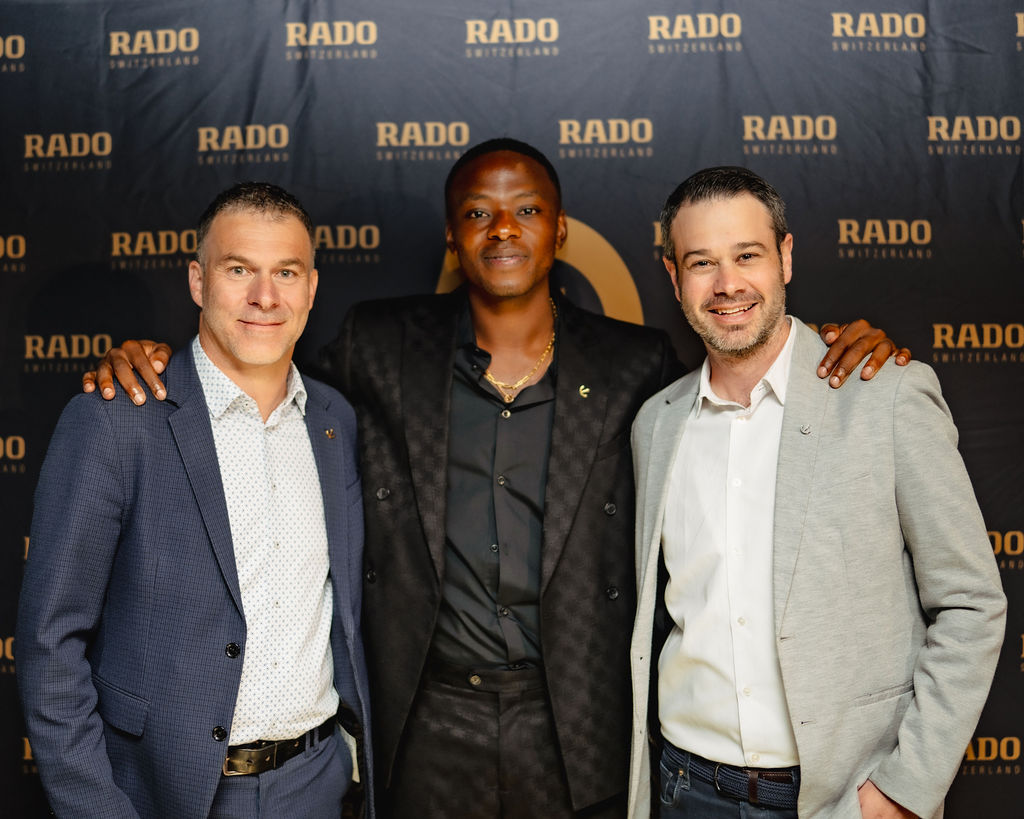
Meanwhile, Rado’s ceramic story was celebrated at a recent dinner in the Ocular Lounge at Zeitz MOCAA in Cape Town. Among the guests was South African fast bowler Kagiso “KG” Rabada, who has joined the company as an international brand ambassador.
His appointment brings Rado’s long association with cricket into the South African market. For local distributor Treger Group, it also marks a first: Kagiso is the only ambassador in the company’s 74-year history to have progressed from a local partnership to an international role.
The connection between athlete and brand may be expressed through familiar ideas of timing and precision, but KG placed greater emphasis on the relationship behind the campaign. “What I see is a partnership,” he said, “a partnership that’s going to go a long way.” He also spoke about the warmth of the occasion and the people involved. “It’s not just about what you read and what you think. It’s also about what you feel.”


That sense of personal connection is relevant to a material best understood through wear. The engineering behind high-tech ceramic is complex, but its advantages are straightforward. It’s light, smooth against the skin, and resistant to marks from daily use.
Forty years after the Integral, ceramic is widely used across Swiss watchmaking. For Rado, however, it’s the result of a search that began decades earlier and ultimately came to define the brand.