“It took me almost 10 years to solidify my practice to what it is now, where it’s clear and understandable. And there’s a purpose to what I do,” Lulama Wolf Mlambo declares.
As one of South Africa’s leading artists, Lulama is defining the next era of contemporary art across the continent. Her work combines neo-expressionism – the emotive art movement that emerged in New York in the late 1970s – with themes of pre-colonial African experience, creating a distinctive oeuvre of modern African art.


Influenced by the works and philosophies of South African art trailblazers Ernest Mancoba and Mmakgabo Helen Sebidi, Lulama has carved her own path, marked by international showcases and brand collaborations with retail giants such as H&M and Superbalist.
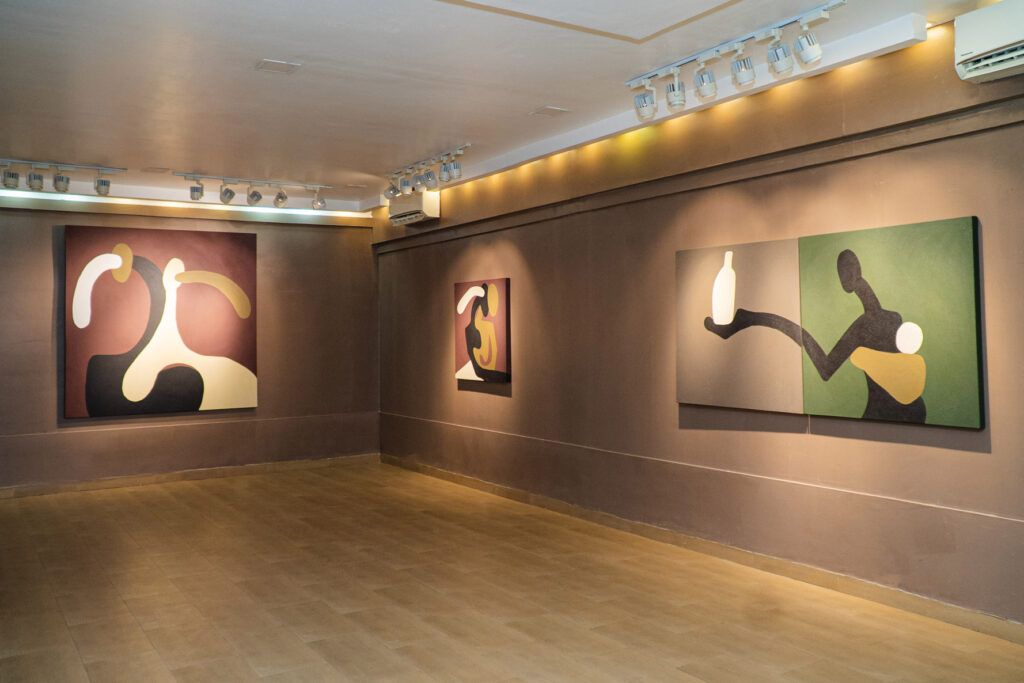
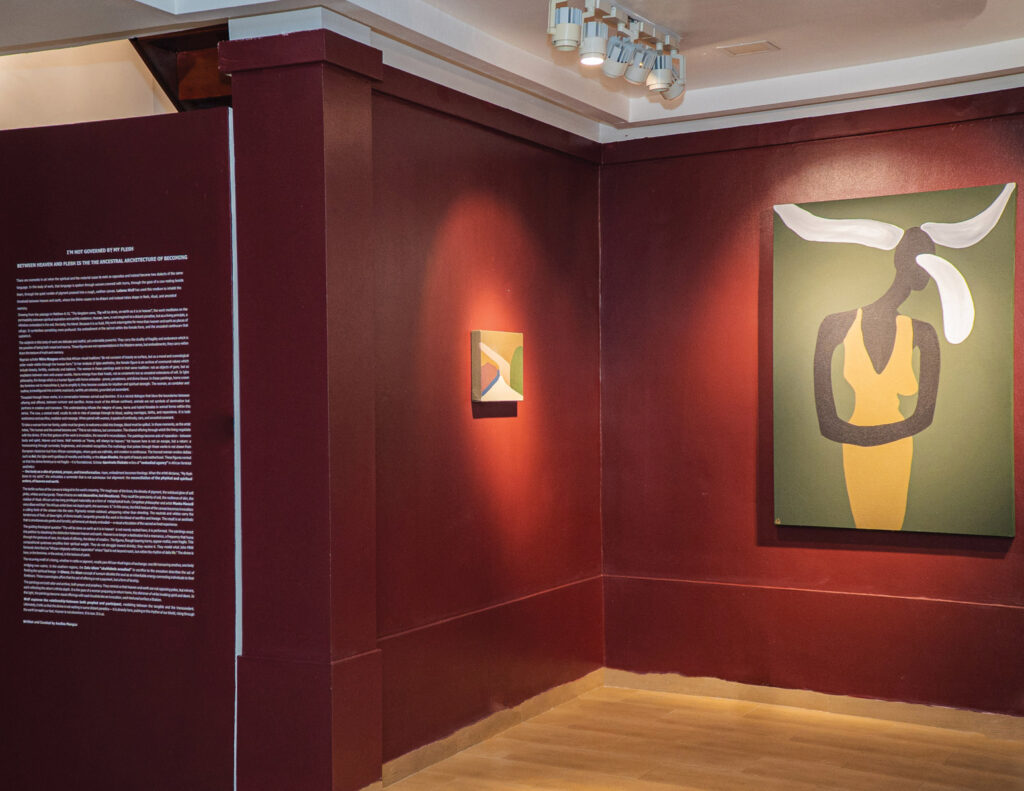
Earthy colours, natural elements, and striking patterns found in vernacular architecture set the foundation for the dark, faceless figures in her paintings.
Her childhood, she says, was filled with wonder, learning, and trying out different hobbies. As a Xhosa child growing up in the Free State, she also mastered the art of adapting early on – a skill that has contributed to her success over the years.
When the artist couldn’t complete her studies in fashion and art at the University of Johannesburg due to a lack of funds, she chose to commit full-time instead of giving up.
“By my third year, I was practising.I had no choice. I had to be decisive,” she explains.
From there, everything fell into place.
When I chat to Lulama in early January, she’s still on holiday at St Francis Bay, a scenic coastal town in the Eastern Cape. She’s attempting to prolong her time with family for as long as possible before returning to her studio in Johannesburg.
Since becoming a mother last year, her view of the world has intensified, and downtime is now a necessity.
“I’m taking my health and wellness more seriously,” she reveals with a chuckle. “I feel invigorated and inspired, and I’m ready to see the world with new eyes as a mother.”

These days, reading, writing, and exploring new mediums are just some of the leisurely activities she finds herself indulging in. It’s almost like going back in time.
Grounded in memory, material, and meaning, Lulama’s work is guided as much by intuition as it is by experience.
Here, she reflects on her journey, process, and the values that underpin her practice.
In Conversation
YLA: How did you discover your passion for art?
Lulama: Art is something I grew up with. My mother taught us how to use our hands, so I grew up exploring various creative hobbies from sewing and painting to drawing. Everything was tactile for me.
YLA: How do you approach your creative process?
Lulama: It’s instinctive. I always circle back to how I grew up. I don’t chase perfection. In a world of AI and flawless, clinical aesthetics, I’m attracted to the opposite, doing the best I can and achieving excellence in imperfection because there’s a humanness in that. Even though I know I’ll never be perfect, I still strive for excellence in that moment.
YLA: When you translate vernacular architectural techniques into your art, do you see yourself as preserving tradition or reinventing it for a modern gaze?
Lulama: I’m drawn to archiving history, to make it digestible in today’s world and context. I use my art to document historical and cultural elements and bring that into the present through a contemporary lens.
YLA: What role do you think AI will play in the future of artistic expression?
Lulama: I believe some industries need AI, but not necessarily the art world. There’s something about our handiwork that will never be duplicated by technology. I believe we don’t need it in creating the art itself, but maybe it can support the business side of our work.
YLA: How would you say motherhood has influenced your creative voice?
Lulama: Motherhood has been an interesting revelation, but also a certainty that this is what I should be doing. Storytelling remains a part of that. My intention going forward is to be more present and to set a good example for my daughter.
YLA: What does community mean to you?
Lulama: People are a big part of how we see ourselves because they act as mirrors. I enjoy getting perspectives from different people. It creates room for correction, accountability, and learning.
YLA: Your recent exhibition, I’m Not Governed by My Flesh – showcased at Affinity Gallery in Lagos, Nigeria – explores the connection between heaven and earth, spirit, and flesh. How does spirituality, religion, and ancestral presence influence your work?
Lulama: I started creating for that show during my pregnancy, and it was an act of surrender –a love letter to God. I say a love letter because I was in awe of that entire journey and who I was throughout that experience.
In the works, I challenged myself to see colour, textures, and spaces differently so that they don’t overpower the canvas but give it the presence it needs.
YLA: Tell us about your upcoming exhibition at Investec Cape Town Art Fair.
Lulama: I’ll be showcasing as part of a group show named Home/land. The artworks are a continuation of I’m Not Governed by My Flesh. My work and shows always inform each other.
YLA: Would you say you’ve accomplished all the goals you set when starting out?
Lulama: I’ve surpassed my goals. The last seven years have been wonderful, and the standard keeps getting higher. Working with incredible galleries and brands, travelling the world, and being featured in books is amazing. It’s given me the audacity to want more.
The 13th edition of Investec Cape Town Art Fair takes place from 20–22 February at the Cape Town International Convention Centre.