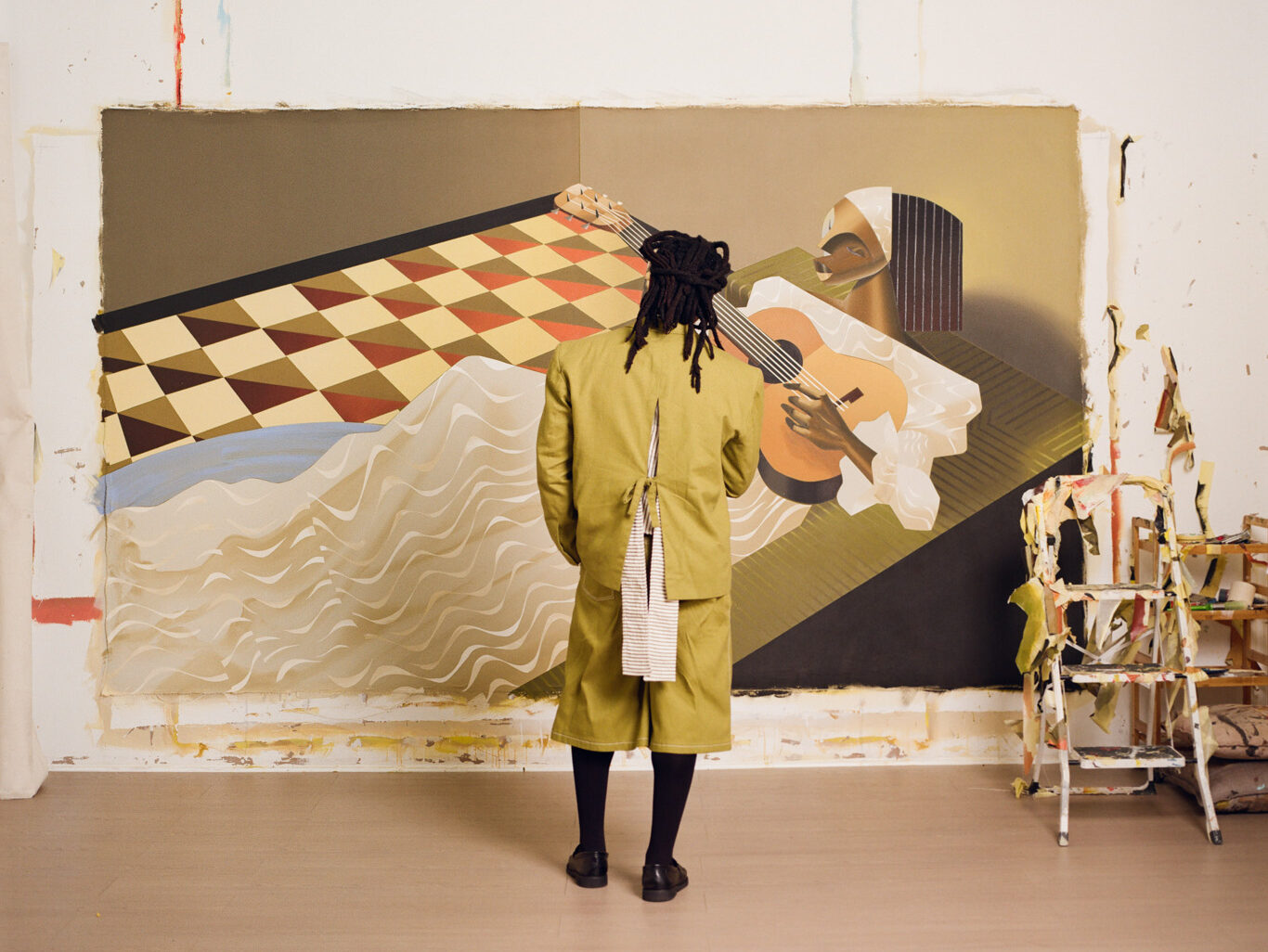
Terence Ntsako Maluleke’s work sits at the intersection of animation and fine art, creating a distinct visual language inspired by the Black urban and township experience. His pulsating paintings stand out for their crisp graphic lines, strikingly precise figures, and bold colours that capture the vibrancy and dynamic essence of contemporary African life.


Below, the artist opens up to YourLuxury Africa.
YLA: As a relatively accomplished animator, what fuelled your transition from animation to painting?
Terence: I’d say I’m a visual developer and director first, then animator; I lean more into the art direction side of things. I don’t actually see it as a transition. It’s adding to the language of visual storytelling.
What really fuelled my excitement about fine art was the need to confront my own feelings and emotions more immediately. Animation can take a lot of muscle to get off the ground. Painting felt like an immediate way to resolve some of these ideas and feelings.

YLA: Did you feel pressure to prove yourself as a painter?
Terence: I don’t think of myself as a visitor. I love the feeling that I have always been there. When the pressure creeps up, I remember that I was always a painter. That I existed in that room before I arrived, and that I will exist in it for many years to come.
YLA: In what way does animation inform your work as an artist?
Terence: Beyond how the work looks – the geometry, breaking shapes down to their simplest form – animation showed me something else. It taught me how to transform meaning into imagery.
My fine art is imbued with meaning through storytelling – whether that’s love, my relationship with faith and sometimes a lack of it, my community, and how I see myself in relation to the world. Animation can help articulate some of these big questions.

YLA: The characters in your compositions stand out for their style. What role does fashion play in your work?
Terence: It’s less about fashion specifically. When anything is carefully considered, there’s humanity in it. How we deeply consider what we’re wearing, and the story behind it, is a way of articulating the care with which we show up in the world.
YLA: You also have a distinctive sense of dressing. How would you describe your personal style?
Terence: This is a tough one because I don’t think of myself as someone who cares that much about that. But I’m a painter, so most of my clothes end up with paint on them. Paint drips on the fabric, and I think that adds its own level of personal style.
I also wonder if being a painter almost negates the need to have a considered personal style. In my opinion, if you are a painter, be a painter! That’s the source. That’s the style.

YLA: Your grandfather and uncle were painters. What lessons did they teach you about art and creativity?
Terence: The biggest thing was the magic of mixing colours. As a child, I was mind-blown by the idea that you can mix certain colours and make a new one, so I already had this view of my grandfather as some sort of musician or wizard.
I also learned how isolating the practice can be. I’d find him in his room, usually working alone. Sometimes, to avoid that isolation, he’d go to a tavern to drink while he worked, to form some sort of community around himself so the practice wouldn’t feel so solitary.

YLA: Which artists, dead or alive, do you look up to?
Terence: Tamara de Lempicka, Diego Rivera, and Gyimah Gariba.
YLA: Creatively, what ideas or questions are on your mind right now?
Terence: I’m playing with different elements of stop-motion and animation within the fine art space. I’m an animation storyteller at heart, so I always want to infuse those worlds.
These very obscure, abstract animations don’t quite make sense at the moment, but I enjoy making them.