“This anniversary is more than a celebration. It is a reaffirmation of our commitment,” says Cyrille Vigneron, Chairman of Cartier Culture and Philanthropy. In a world where startup success is often measured by billion-dollar valuations and rapid exits, the Cartier Women’s Initiative has spent the past two decades championing a different definition of entrepreneurship: one where commercial success and social impact are inseparable.
A Different Kind of Entrepreneurship
Founded in 2006, the Cartier Women’s Initiative was created to identify, fund, and support female entrepreneurs whose businesses address some of the world’s most pressing environmental and social challenges. What began as an annual awards programme has evolved into a global fellowship, offering financial support, executive leadership training, business coaching, academic learning, and access to an international network of entrepreneurs who continue supporting one another long after the awards ceremony ends.
I got a sneak peek at the alumni WhatsApp group, where more than 300 women founders continue to share advice and support long after the fellowship ends. It’s impressive to see how Cartier has connected women across borders over the past two decades.
Over the years, the initiative has expanded from recognising a handful of entrepreneurs to supporting founders across nine regional awards – Latin America and the Caribbean, North America, Europe, Francophone Sub-Saharan Africa, Anglophone and Lusophone Africa, the Middle East and North Africa, East Asia, South Asia and Central Asia, and Oceania – alongside the Science & Technology Pioneer Award.
Each year, 30 fellows are chosen, with first-place winners receiving $100 000, second-place recipients $60 000, and third-place fellows $30 000, in addition to a year-long fellowship programme.
Women Lighting the Path
Its 20th anniversary, celebrated in Bangkok under the theme Women Lighting the Path, felt less like a retrospective and more like a glimpse into the future. As Cyrille explains, “The achievements of these women transcend borders and generations. Their journeys shape a future that is more inclusive, more resilient, and honour progress while inspiring the wider ecosystem to progress with invigorated commitment.”

Those journeys were brought vividly to life during the Cartier Dialogues, where we got to hear from speakers like psychologist and executive coach Dr Lisa Orbé-Austin, who explored imposter syndrome alongside Cyrille. Amal Clooney (who was as glamorous as she was inspiring) and professional boxer Ramla Ali explored courage, kindness, and leadership. The conversations set the tone for a week dedicated not simply to celebrating achievement, but to examining the mindset required to create meaningful change.
Building Businesses That Create Impact
The significance of the Cartier Women’s Initiative lies in its refusal to treat entrepreneurship and impact as opposing forces. Rather than funding charities, it invests in commercially viable businesses solving systemic problems – from financial inclusion and healthcare to education, sustainable fashion, food security, and climate resilience. The emphasis is not simply on rewarding innovation but on building businesses capable of scaling that innovation.
The programme’s evolution reflects that philosophy. The introduction of its fellowship model in 2020 shifted the focus from recognition to long-term acceleration, combining leadership development with mentorship, executive coaching, and lifelong access to a global community of founders.

Walking through the halls of Chulalongkorn University during the awards ceremony, hosted by writer and broadcaster Sandi Toksvig, one thing became unmistakably clear: these women were not waiting for permission to lead. They were already reshaping industries, creating jobs, and solving challenges that governments and corporations have struggled to address for decades.
For Cyrille, that is precisely the point. “When given the means to lead, innovate, and create, women can redefine the future,” he says.
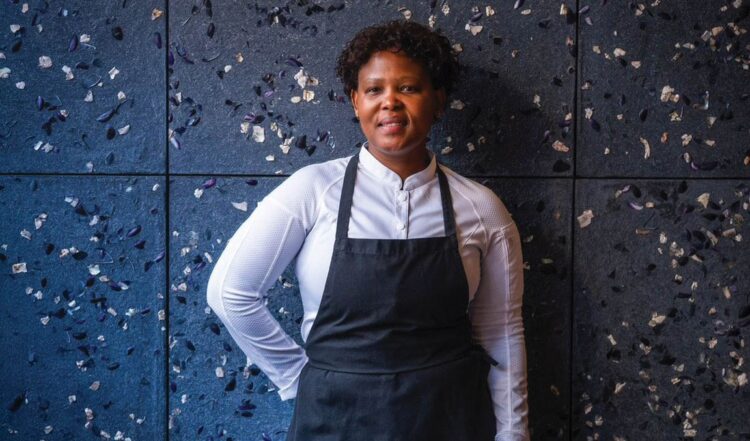
At Bangkok’s Dusit Thani Hotel, where the Maison celebrated the initiative’s milestone anniversary, two African founders demonstrated how locally rooted businesses can create global change.
Fashion with Purpose

Susan Namirimu never imagined that a tailoring workshop would become the catalyst for transforming the lives of hundreds of women in northern Uganda. The founder and CEO of Mtindo traces the beginning of her journey to a young woman named Beatrice, who arrived at her workshop searching for an apprenticeship.
“The opportunity to work with me gave her not only an income but also the independence she deeply craved,” explains Susan. “Witnessing how this changed her life made me realise that fashion could be more than creativity; it could be a vehicle for empowerment.” That realisation became Mtindo.
Today, the company operates through a dual model: Mtindo Academy trains unemployed young women in practical tailoring skills, while Mtindo Studio provides paid employment producing garments for local and international brands. The result is an ecosystem where education immediately translates into economic opportunity. To date, the business has trained 227 women, creates around 50 jobs annually, and has increased participating tailors’ incomes by 38 per cent.
Yet despite these impressive numbers, Susan insists that empowerment extends beyond employment. “Meaningful empowerment for women entrepreneurs goes beyond access to funding,” she says. “It means equipping women with the skills, networks, and confidence to build businesses that are sustainable and impactful.”
Susan believes the Cartier Women’s Initiative has reinforced that philosophy. “My experience with the Cartier Women’s Initiative has reaffirmed my purpose of creating opportunities for women through social entrepreneurship. It has shown me the power of innovation rooted in care and responsibility.”
Operating in Uganda has required resilience as much as creativity. “With limited infrastructure and systems in place, we often have to find innovative ways to overcome challenges and keep moving forward,” she says. “The market is full of untapped potential. There is always room to innovate, grow, and create solutions that truly make a difference.”
From Investment Banking to Bespoke Biscuits

Thousands of kilometres away in Cameroon, Adeline Pelage found herself asking a deceptively simple question while walking supermarket aisles. Why were imported biscuits dominating the shelves while local farmers struggled to create value from crops grown just kilometres away?
After spending more than a decade in investment banking between Paris and Africa, Adeline returned home determined to build something different. “I often joke that I went from analysing financial models to analysing biscuit textures,” she laughs. “At some point, I stopped asking myself, ‘Why doesn’t this exist?’ and started asking, ‘Why not build it?’”
The result was Biscuiterie Bobo, a company producing preservative-free snacks made from locally sourced crops such as sweet potato and cassava. More than simply manufacturing biscuits, the business has become a vehicle for strengthening local agriculture, creating employment and reducing dependence on imported foods.
The company supports more than 100 smallholder farmers, sources over 80 per cent of its ingredients locally and has created more than 100 direct and indirect jobs, 60 per cent of them held by women.
Adeline believes recognition from Cartier validates years of invisible work. “Cartier Women’s Initiative gave us something very powerful: visibility, credibility, and a global community,” she says. “As entrepreneurs, especially in Africa, we spend years building quietly – solving problems nobody sees, making payroll, fixing machines, convincing suppliers, and reassuring teams. Then suddenly, a recognition like Cartier shines a light on all those invisible years.”
Her advice to aspiring entrepreneurs is refreshingly pragmatic. “Don’t wait for perfect conditions. They don’t exist,” she says. “Build real businesses, not just beautiful presentations. Impact is important – but profitability matters, too. A business that survives creates far more impact than a business that only inspires.”
Looking to the Next 20 Years
Twenty years after its inception, the Cartier Women’s Initiative has become far more than an awards programme. It is a global community built on the belief that entrepreneurship can improve lives, strengthen communities, and create more equitable economies. And if the stories of Susan and Adeline are any indication, the next 20 years may prove even more transformative than the first.
I echo Amal’s sentiment: “To the Cartier Women’s Initiative fellows of 2026, I want to say: congratulations. What you do is not easy. Stay committed, stay courageous, and remember that the only way to fail is not to try.”